Details
Game Designer: Krzysztof Belczyk
Art Direction: Patryk Jędraszek and Adrian Radziun
Publisher: Awaken Realms
Player Count: 1-5
Estimated Play Time: 120-240 minutes
Box Size: 15in x 13in x 7in
Quick Debrief
In this cooperative boss battler, two to five Hunters take on a single massive enemy called a Griefbound, alongside its minions and an elite enemy. Hunters lose if time runs out or anyone dies. To win, kill the Griefbound before it kills you. Pick your scenario, build your team, and get straight to the fight.
I’ve really enjoyed playing Grimcoven. The sundrop miniatures and gothic atmosphere are immediately striking. The game earns its massive table presence, but the scale between the Hunters and the towering Griefbounds puts you inside the fight. The dice placement system is the mechanical heart, and it rewards planning over luck. Each session feels different enough that I finish one already planning the next.
The setup and organization ask a lot of you, especially if you own all the content. The walkthrough scenario is also a poor first impression. Don’t judge the game by it!
Current Status: Essential Equipment (Must Own)
Overall, it’s essential in my collection and I’d recommend it to any fan of boss battlers, cooperative strategy games, or miniature-heavy productions that deliver on atmosphere. If you don’t mind the table space requirement and setup time investment, there’s a deeply satisfying game waiting on the other side.
Initial Observations
I had been following Awaken Realms’ Gamefound projects for a while after playing Dragon Eclipse and Castles of Burgundy: Special Edition. Dark, Victorian horror isn’t usually my genre, but the combination of grim hunters and large, threatening enemies pulled me in. This game has an immediate sense of spectacle and the miniatures only add to the drama. I backed Grimcoven on Gamefound in June 2024 and received the Special Edition core box with sundrop miniatures. I was happy with my previous all-in pledges so I opted for extra content:
- Personal Stories
- Hunters expansion
- Forgotten Entities expansion
- Renegade Hunter mini-expansion
- Terrain miniatures
- Companion miniatures
- Acrylic tokens
- Neoprene play mats
Gameplay
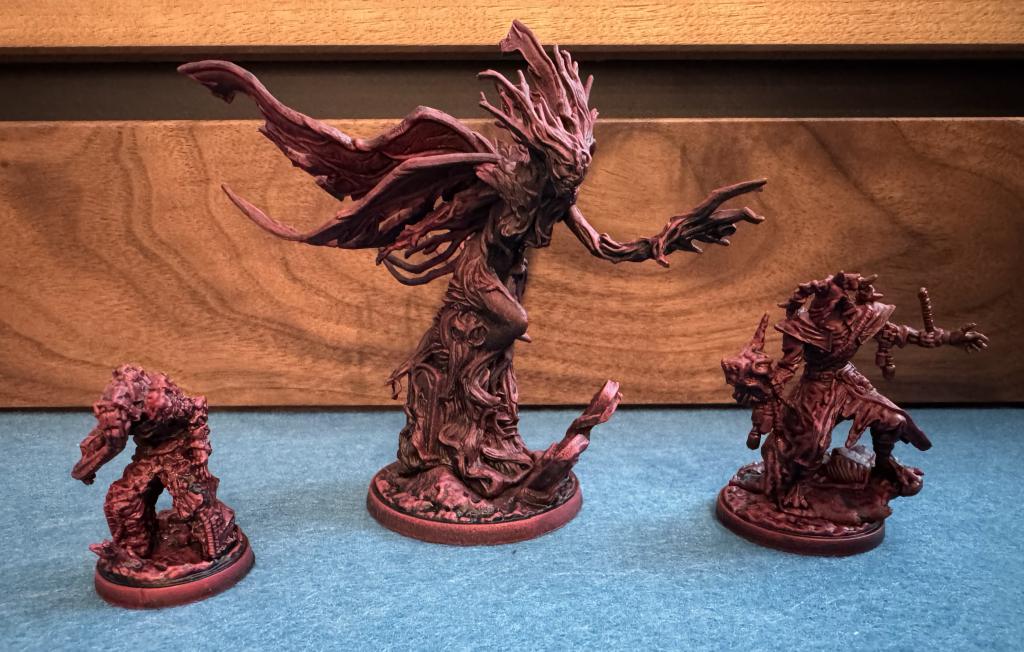
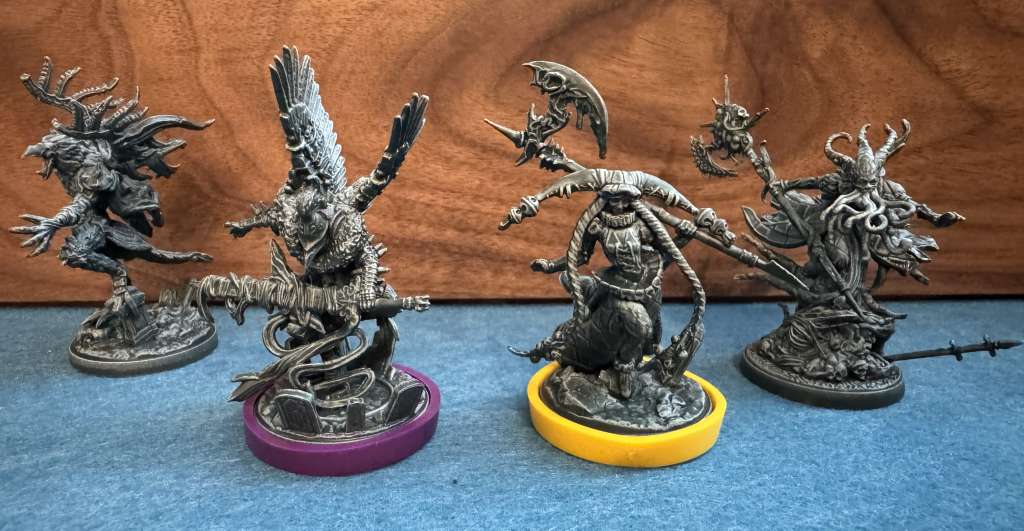
At first sight, Grimcoven is a daunting board game with a large table presence. The giant boss miniatures called Griefbounds genuinely feel threatening, look grotesque, and pull you into the atmosphere. Fortunately, the game helps walk you through its complexity with components like easy-to-read standees guiding you step by step through the enemy phase, so the physical layout becomes your teacher. In this boss battler, two to five Hunters fight one of the many Griefbounds with a variety of elite enemies and minions. If time runs out or one Hunter dies, the players lose. To win, you must kill the Griefbound. Simple stakes, but the road to get there is anything but.
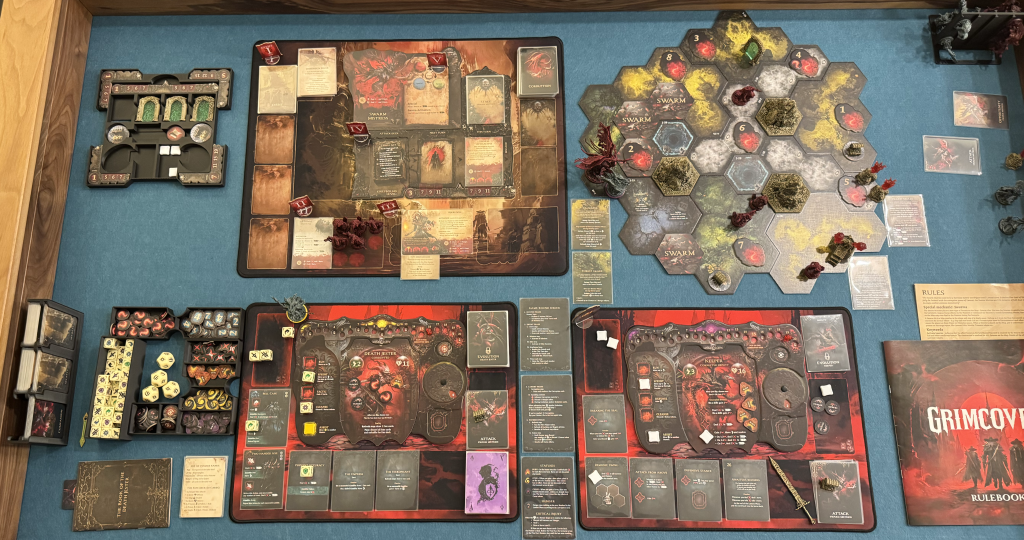
The players are Hunters in this universe who swore an oath to resist the temptation of Lament, a dangerous, corruptive power, while risking their lives to defeat terrifying entities. From the start, this game gives you an impressive number of ways to customize your experience. Each Griefbound comes with five scenarios of increasing difficulty that change the map, cards, and minions, and randomized elements to ensure the same rarely plays the same way twice. Specific terrain and location cards tied to the map offer optional actions that add to the story through secret cards, introduce new obstacles, and can even save you from defeat at a critical moment.
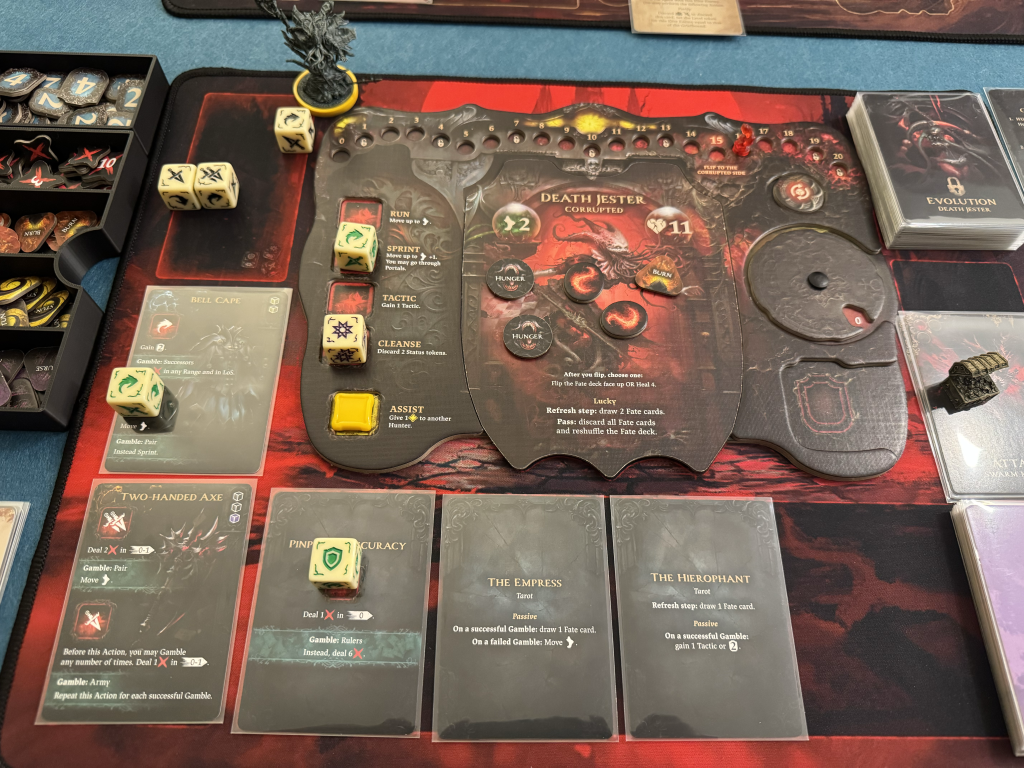
When choosing your Hunter, you also pick their starting weapon and armor, which directly shapes your dice pool. In this game, dice are your action economy. Once rolled, you match symbols on the dice to symbols on your cards and player board. This strategic placement puzzle is where the game shines. It never feels punishing because you’re generally using dice that weigh your odds toward specific symbols you need, and specific abilities allow you to reroll or share dice symbols with other Hunters.
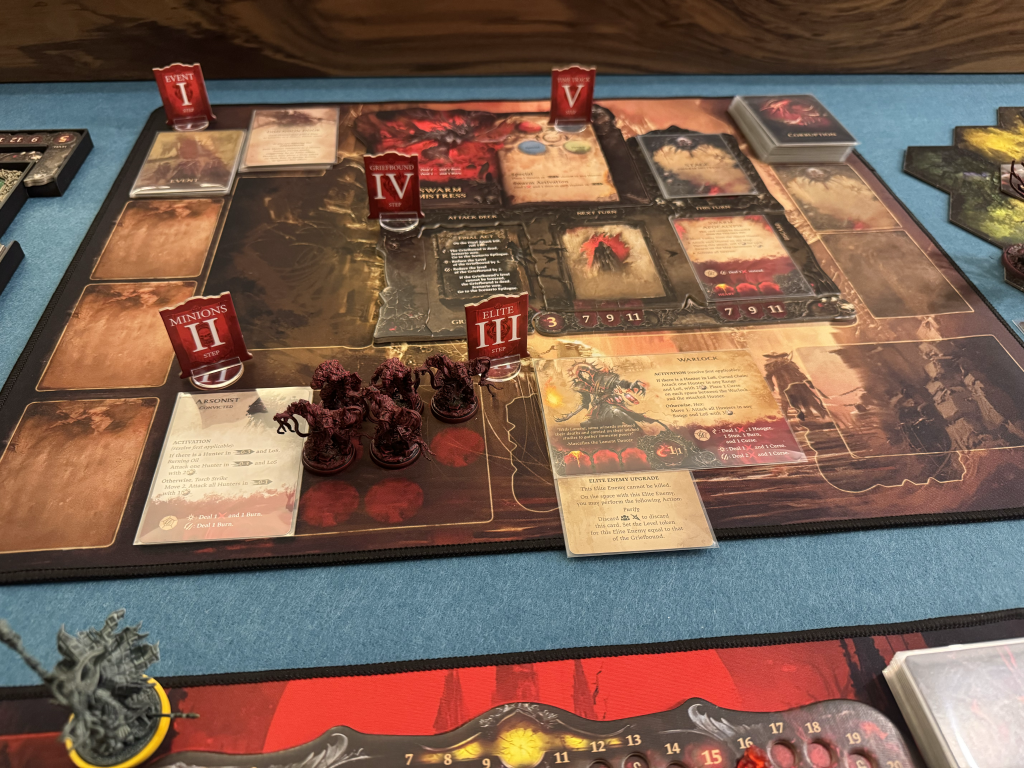
Turns stay quick and snappy despite the game’s complexity. Each Hunter is limited to two actions per turn before passing clockwise, which keeps the game moving, forces teamwork, and prevents downtime that plagues heavier games. The Hunter phase can still run long as players choose who to attack, where to move to stay safe from the Griefbound’s next strike, and how to split resources like treasure chests and Lament. But when the Enemy Phase begins, it runs on rails.
Players must survive a random event card, the activation of up to eight minions, the activation of a powerful Elite enemy that has the maddening ability to return after death, and the Griefbound itself. Crucially, all enemy actions are telegraphed through face up cards, and Griefbound’s next two attacks remain a known quantity. That transparency enables the kind of fun, tactical planning the Hunters phase is built for.
There’s still randomness to wreck a well-laid plan. Each Hunter must draw a corruption card every round, and Lament, while powerful, raises your corruption level and makes those cards nastier. Feeling hungry? It’s quite possible that you’ll turn on your fellow Hunters mid-battle.
In games like Power Ranges: Heroes of the Grid, dice determine damage output. I still remember rolling eight dice in Power Rangers Heroes and doing zero damage to the enemy. There is nothing more frustrating than randomness dismantling your carefully built turn. Grimcoven, like Scott Pilgrim Miniatures the World, uses dice differently. They determine which actions you perform, and those actions have fixed damage values. Removing damage output randomness from the player side is a smart design call, and it makes growing your dice pool genuinely exciting. More dice means more options and a richer decision space, not just bigger damage. The game designer was equally clever on the enemy side, tying their damage directly to enemy dice rolls so the opposition stays unpredictable.
Field Testing and Replayability
One warning before you sit down to play for the first time: don’t let the walkthrough color your opinions of the real game. The walkthrough does a poor job of marketing the fun by throwing you into an uphill situation. I played the playthrough and lost almost immediately. It wasn’t until a proper scenario that I understood what makes the game click.
I expected to feel overwhelmed and reluctant to dig into all the playable content. Playing both solo and as a two player experience changed that. The game is more balanced and accessible than it appears from the outside. The solo mode Deputy mechanic is a good enough solution that a solo game feels as good as two players. I don’t see myself playing at the maximum of five players, but a three player game that will fill my tabletop, or a two player run, both feel right. With each game, you get faster at game setup and more capable against each Griefbound’s attack card. Learning each Hunter’s strengths and weaknesses has been half the fun.
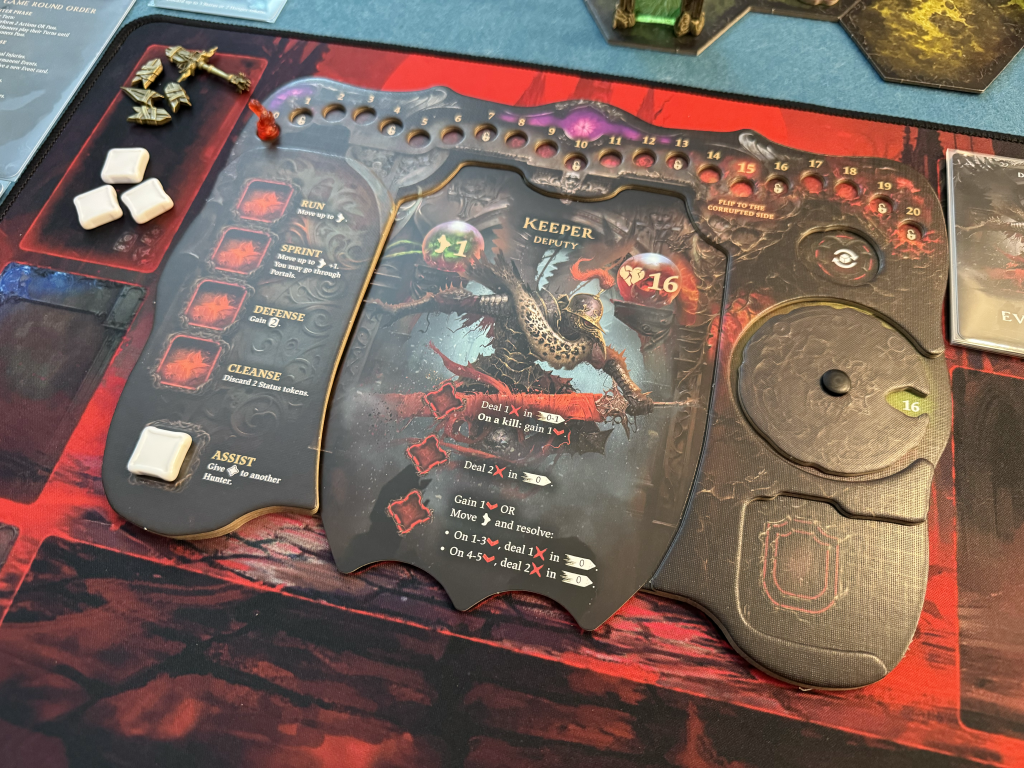
My current favorite Hunters are the Gunslinger, Keeper, and Technomancer. Each one illustrates how differently a Hunter can feel to play. The Gunslinger rewards positioning. You’re forging bullets and choosing exactly when to spend them for bonus damage or special effects so every attack feels like a decision rather than a routine maneuver. The Keeper is the team’s tank. Slow to move at first, built to absorb punishment, and steadily growing into a damage powerhouse as he assembles pieces of his demonic sword. Watching that sword come together over the course of a battle is its own kind of satisfaction. The Technomancer plays differently from either of them as a complex support character with a unique technology die. She can toggle between powering up weapon or armor attachments depending on what the team needs. Put any combination of Hunters on the table and no turns look alike, which is exactly the kind of variety that makes you want to try a different team the moment a game ends.
Even scenario one against the Graveyard Dragon has felt fresh both times I’ve played it, thanks to randomized attack cards and landmarks. The portals are a good example of how the game generates memorable moments. Sometimes you don’t have enough movement to use them, or certain effects render them useless entirely. But when you can land a killing blow on a piece of the Griefbound and then sprint through a portal to dodge a counter-strike, you feel like you’ve survived a moment in a larger war.
Whenever I leave the table already thinking about what I’d do differently next time, I know a game has real replay value. I’ve had multiple conversations after sessions about Hunter combinations and whether we’re ready to push to a higher scenario level. There are also so many minions variants and environment-linked secret cards that a single battle only scratches the surface of what’s in the box. Heavy, cumbersome to organize, but worth it the moment you sit down.
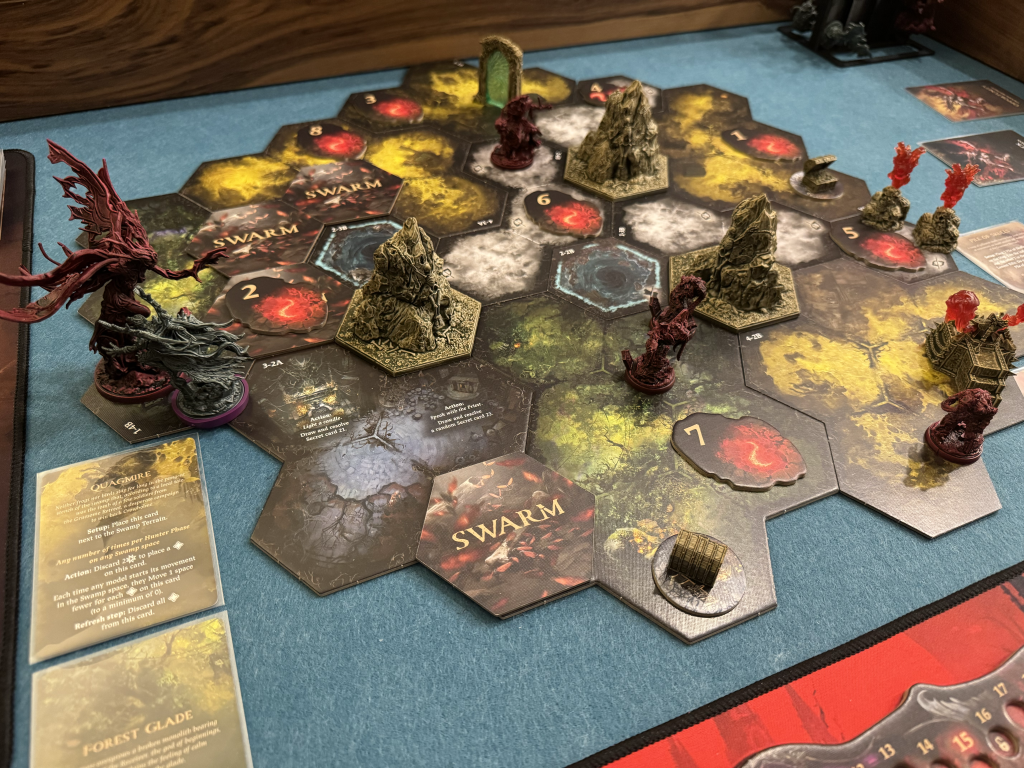
Difficulty modifiers let you tune the experience in both directions. For a first playthrough, I recommend a few easy-mode tweaks. Most just give you a head start on powering up for round one. The Rapid Hunt mode is also worth considering as a standard game can stretch across a couple of hours. This mode cuts the runtime by starting you mid-fight.
Notable Discovery: Corrupted Hunters
My excitement peaks every time I get to swap out my Hunter miniature for its corrupted form. And the path to get there is one of the game’s best mechanics. Lament, the resource that fuels the Griefbound themselves, is also available to Hunters. Spending it levels you up, unlocking evolution cards that might give you an extra attack, or simply an extra die. One die sounds like a modest reward until it’s the resource that lets you pull off a killing strike or pass a crucial symbol to complete a teammate’s combo.
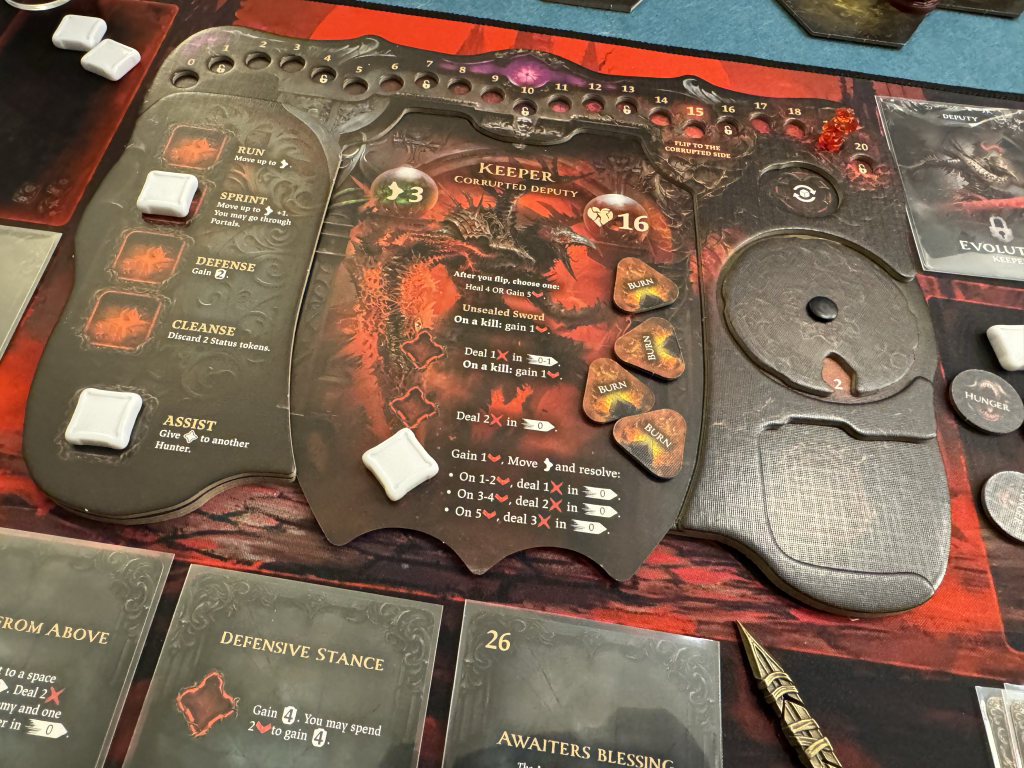
Hunters can also gain hunger tokens which force attacks against your allies. Though my game group hasn’t worried too much about hunger, because collecting more Lament is the only way to flip your player board to the corrupted side. New forms come with new abilities and perks that build on the strength you’ve been stacking through evolution cards. That said, higher corruption has real costs. Negative effects become more frequent, hunger grows, and you risk becoming a Pretender where your Hunter converts into a Griefbound for others to hunt. You can sprint towards corruption deliberately or manage it carefully. Both are valid strategies. Both have consequences.
Notable Discovery: Personal Stories
Grimcoven is not a campaign game with a continuous storyline. Any Griefbound scenario can be played with any team of Hunters, without need to start from the beginning. That said, there is lore woven throughout the Griefbound scenario books and flavor text on the cards themselves. The Personal Stories expansion gives you a way to pull on those threads.
Each Hunter gets a story booklet with missions tied to their playstyle. Complete the Death Jester’s mission of two successful gambles in a single round, for example, and you unlock new cards and story passages that reveal how that character fits into the world. The characters already have distinct designs and mechanics; Personal Stories add motivation. The unlockable cards also give each Hunter additional replayability. My practical note: the story passages can run long so I recommend treating them as a post-game epilogue like a way to wind down after the battle where the Hunters share what they went through. This will preserve pacing during the game and gives the stories their own time to shine.
Observer’s Notes
If you go all-in on the content, the sheer volume of components becomes its own challenge. The core box barely fits everything with miniatures, and organizing it without a system is an exercise in frustration. I solved this by buying a custom insert from Etsy, which lets me fit all expansions, add-ons, sleeved cards, and miniatures into the core box and the Forgotten Entities expansion box. Setup is noticeably faster now, and two boxes instead of a pile saves valuable space on crowded shelves.
Field Report Summary
Current Status: Essential Equipment (Must Own)
- Rules Accessibility: The game looks overwhelming at first, but each step is numbered and approachable. The rules themselves are not hard to understand, which makes for a comfortable learning curve, though small details are easy to miss on a first read of the rulebook. Each Hunter and Griefbound brings its own unique rules and, fortunately, Awaken Realms provides an FAQ and errata (link).
- Replay Potential: I played scenario one of the Graveyard Dragon twice and each felt genuinely new. Between the variety of Hunters, scenario levels, minion variants, map terrains , and landmarks, you’ll finish a session already planning the next.
- Components: The acrylic component upgrades are a mixed bag. Some look like cheap candy and feel out of place next to the rest of the production. Others, like the Keeper’s metal demonic sword and the Gunslinger’s plastic bullets, are thematic and impressive. The cardboard components are uniformly beautiful and legible. The miniatures do the most work. The scale difference between Hunters and Griefbounds pulls you into the world.
- Time Investment: Pre-session setup is the hard part. Once you’ve laid everything on the table, the game starts quickly. Expect multiple hours for a standard game. As you familiarize yourself with the systems, turns move faster and that improvement is satisfying to feel happen across game sessions.
- Portability: Even consolidated into two boxes, this game is heavy and not built for easy travel. I plan to host when I want to play with friends.
- Recommended Team Size: One to three players is the sweet spot. Fewer players means more frequent turns and more time in the action. More players adds strategic depth and planning that suits harder scenarios. The solo mode Deputy can fill the gap of an additional player well enough that you can easily increase your team size.
Leave a Reply