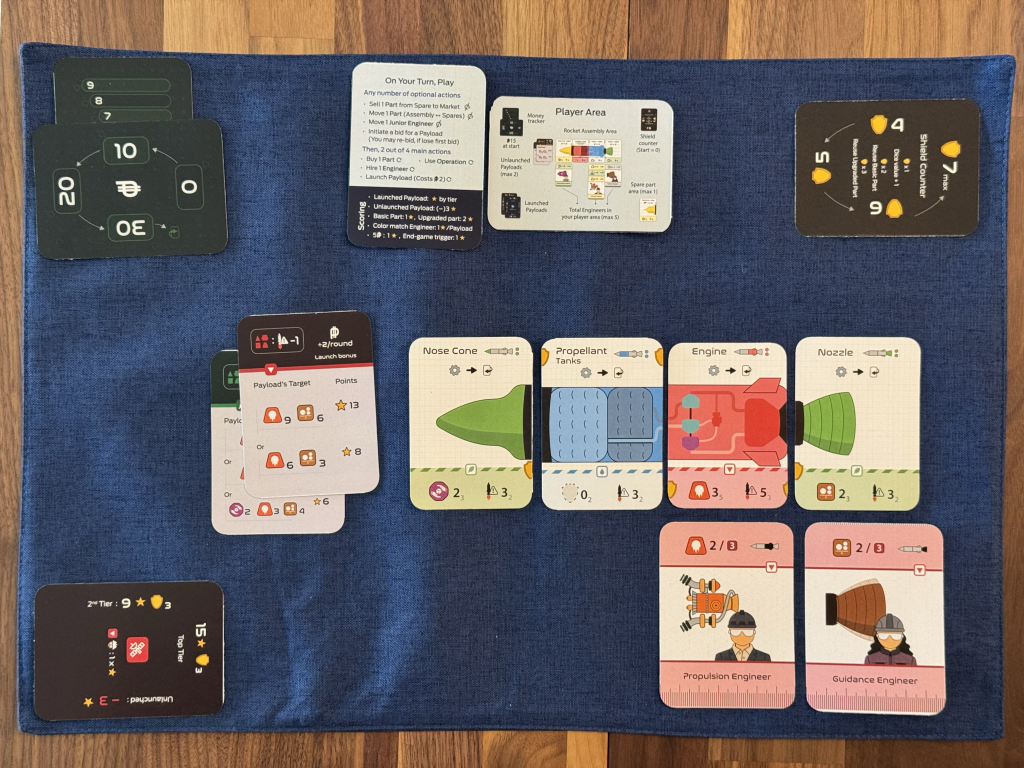
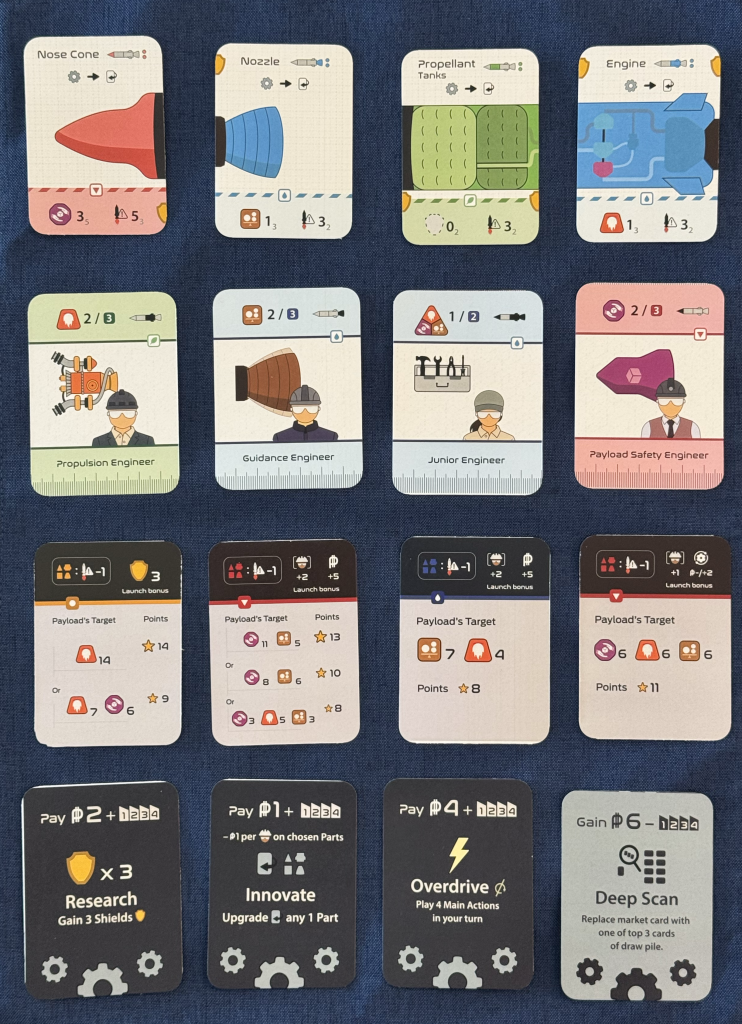
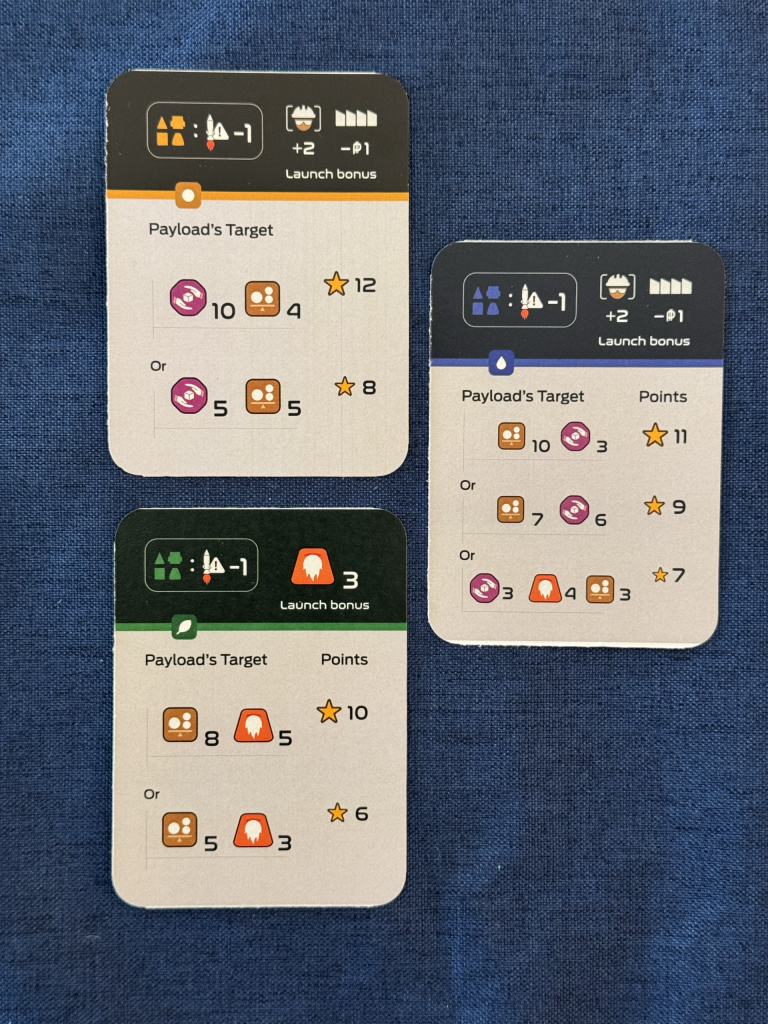
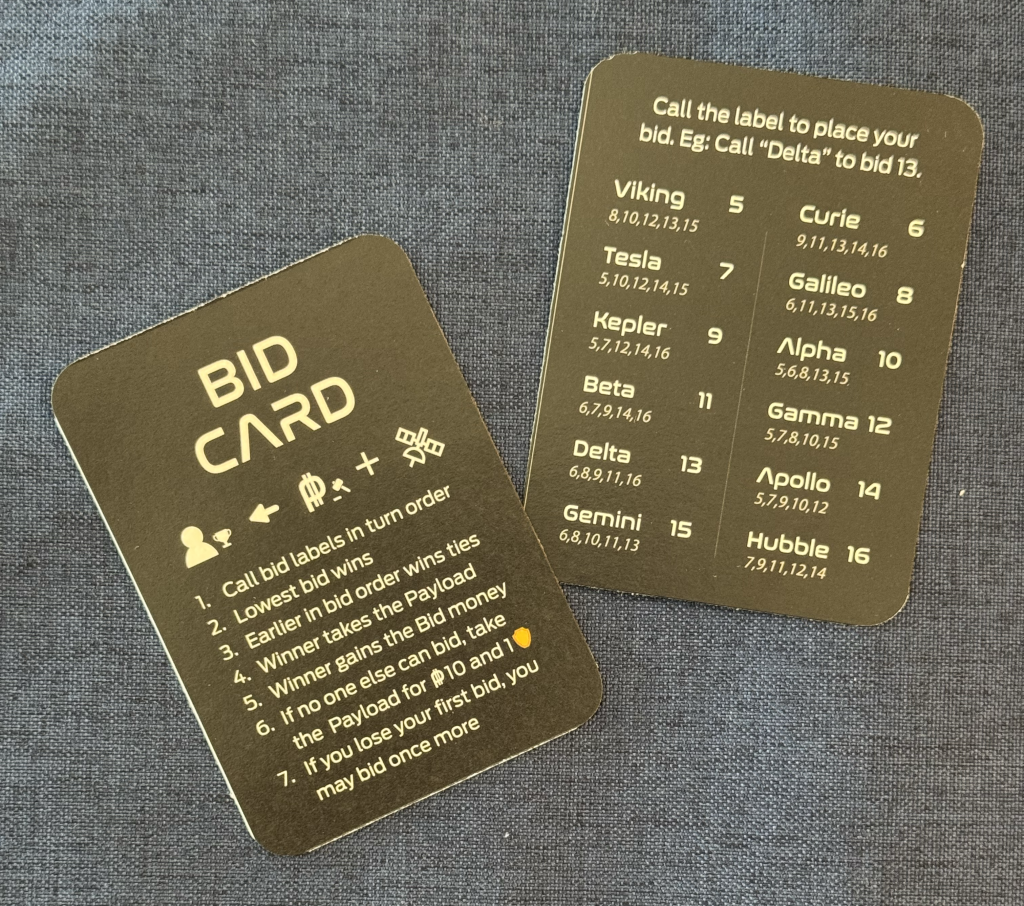
In Payload, you’re running a scrappy space company trying to outmaneuver rivals in a tight launch economy as you bolt together rockets. Contracts are scarce, weather is fickle, and every upgrade decision feels like an engineering challenge. After a few rounds, the table starts to look less like a pile of cards and more like the desk of a project manager overseeing a rocket development projects.
Payload blends clever bidding, a crunchy rocket‑building puzzle, and a surprisingly thematic launch system. The color‑matching and card upgrade decisions feel meaningful, and the Operations layer adds just enough control to keep launches from being pure luck. Weather, exploding tanks, and tight money all contribute to a sense of running a real and slightly chaotic space program.
Payload is a competitive rocket‑building game where players assemble parts, hire engineers, and bid for launch contracts. You’re trying to build rockets that can actually survive the launch sequence, all while managing a tight money economy and reacting to shifting weather conditions each round.
The blind bidding is both a standout and important aspect of this game. Instead of bidding numbers, players call out bid labels tied to hidden values. It’s quick, thematic, and creates a fun uncertainty. You learn to read the table, but you never really know whether your “Gamma” is going to undercut someone else’s “Apollo.” And you have to balance undercutting other players and earning decent profits so that you can actually pay your rocket’s construction costs.
Rocket construction becomes a puzzle of colors and upgrades. You’re constantly trying to keep your Launch Target low enough to survive the launch sequence. Upgrading parts helps lower your risk and increase potential points from your Payload card. Matching colors is important too for gaining shields and other bonuses. This is also tied to hiring the right engineers to help you fulfill your Payload card requirements. But money gets tight fast, and sometimes you are forced to sell Rocket Parts for extra cash. You can’t do everything you want to do, especially because there is a limited number of Payload cards players can complete before the game ends.
Operation cards add a layer of quiet strategy. Cards like Deep Scan and Reload help you manipulate markets and gain additional funds while you can use Research and Breakthrough to boost your chances at a successful launch through Shields and cards upgrades. Overdrive is the most interesting Operation card because it lets you surpass the limit of two main actions per turn. An extra two main actions in a turn could be all you need to buy a rocket part before your opponent or refresh the market to discover the perfect engineer to boost your rocket’s stability. By using these cards, you start to feel like you’re tuning a mission plan and developing a rhythm as you navigate assembling your best rocket and team of engineers.
Launches are the game’s centerpiece and how you ultimately score points. You roll dice one at a time while factoring in the weather die and decide whether to spend Shields to push a roll value higher. Sometimes you abort and take consolation Shields. Sometimes you push your luck and your Propellant Tanks explode. Even failed launches are thematic and as entertaining as a successful launch. And at the end of the day, both send your engineers back to work on the next rocket.
Field Testing
What I enjoyed most is how Payload balances planning with uncertainty. You can build a beautiful rocket and still sweat the launch. You can line up the perfect bid and still lose to a Bid Label you didn’t expect.
The color‑matching puzzle is fun and gives you a clear goal each round. Upgrading parts feels meaningful. Especially as the card markets shift, and money gets tight. I quickly found myself running low on funds after spending a few turns focused on buying rocket parts and hiring engineers. And when the economy starts forcing you to make tough choices, the strategic planning requirement in this game shines through. Sometimes you want to hire an engineer, upgrade a part, and use an Operation card, but you can only afford one.
It’s also a game where the table stays engaged. Launches are shared moments. Bids are shared moments. Even market shifts feel communal. There was a moment early in a game of Payload where someone called out “Delta” during a contract bid, and the whole table paused. Another player responds with “Gemini,” and suddenly everyone is leaning in, trying to remember which bid label might be low this round. It was a small and funny moment that set the tone for the rest of the game.
What kept me invested in my games of Payload were the little moments where the table energy shifts. You can see everyone’s Player Area. Their money tracker, their shields, the parts they are assembling and the corresponding engineers. This leads to a satisfying sense of pressure as you judge your progress relative to everyone else’s and decide how many turns you have to complete your objective.
Notable Discovery: The Weather Die
Each round begins with a weather die roll, and that value becomes one of your three launch dice. It’s a simple addition, but it adds to the game’s theme. Sometimes the skies are clear and you feel invincible; sometimes you’re staring down a “2” and wondering if you should abort the launch for some Shields.
Observer’s Notes
There is a Solo Mode in the rulebook that allows you to play against Tycoon, Earth’s richest space agency. I did not give this mode a try, but I appreciate when designers provide options for solo board gamers.
Field Report Summary
This preview is based on a prototype, so I’m not assigning a final rating. But Payload already shows a strong sense of identity: clever bidding, a satisfying rocket‑building puzzle, and a launch system that creates real tension. I’m curious to play this with more friends, especially to see how the Operation cards flow and how different players react to the bidding system.
Game Design: Andrzej Betkiewicz, Wojciech Frelich, and Kamil ‘Sanex’ Cieśla
Art Direction: Patryk Jędraszek and Kamil ‘Sanex’ Cieśla
Publisher: Awaken Realms
Player Count: 1-2
Estimated Play Time: 60-120 minutes per Scenario
Box Size: 12.5” x 12.5” x 10”
Quick Debrief
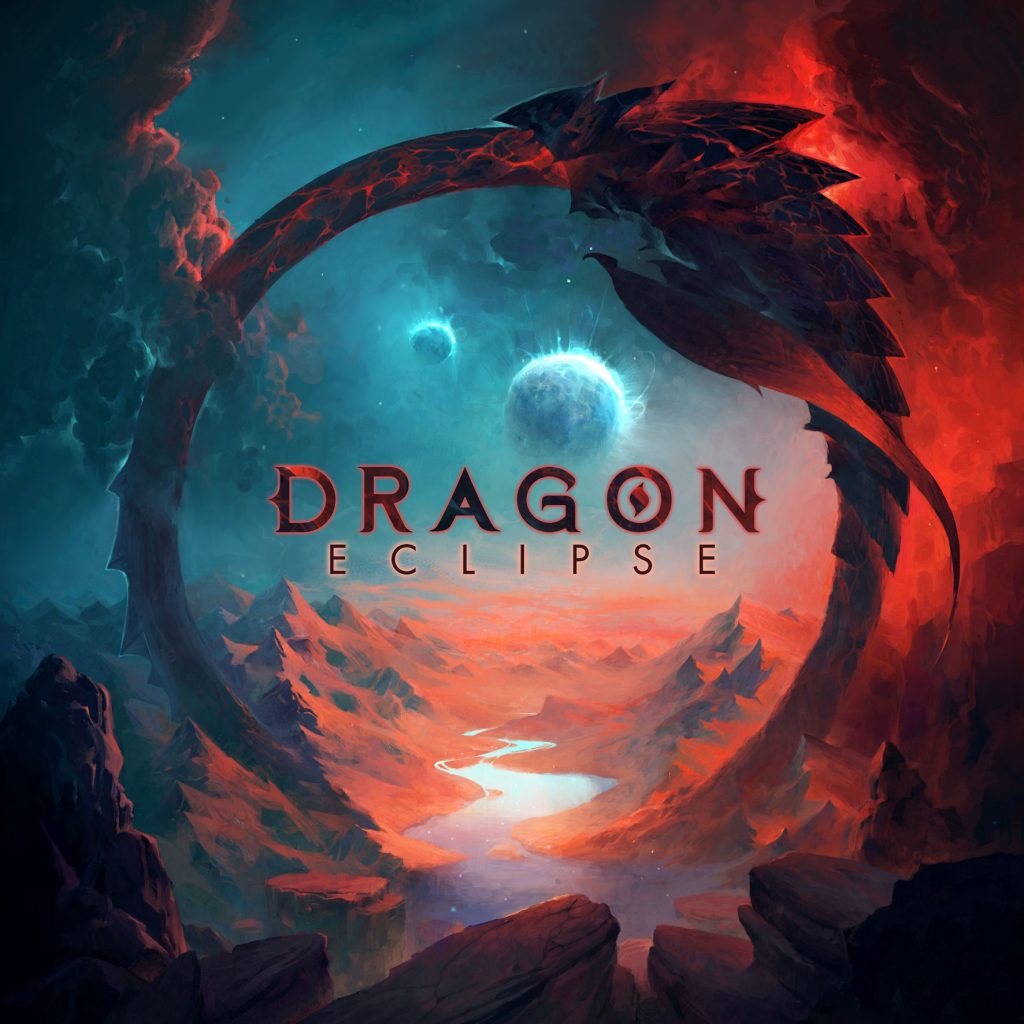
In this cooperative campaign game for one or two players, you take on the role of a Tamer, a gifted individual who bonds with elemental creatures called Mystlings. Each game session is a single campaign Scenario divided into two parts: an Adventure phase where you explore a world on the edge of catastrophe, and a Combat phase where you command your Mystlings across a hex-based arena. Between Scenarios, you customize your creatures’ decks, open new packs of cards, and sometimes watch your Mystlings grow into more powerful forms. The campaign threads it all together across a story of mounting consequences.
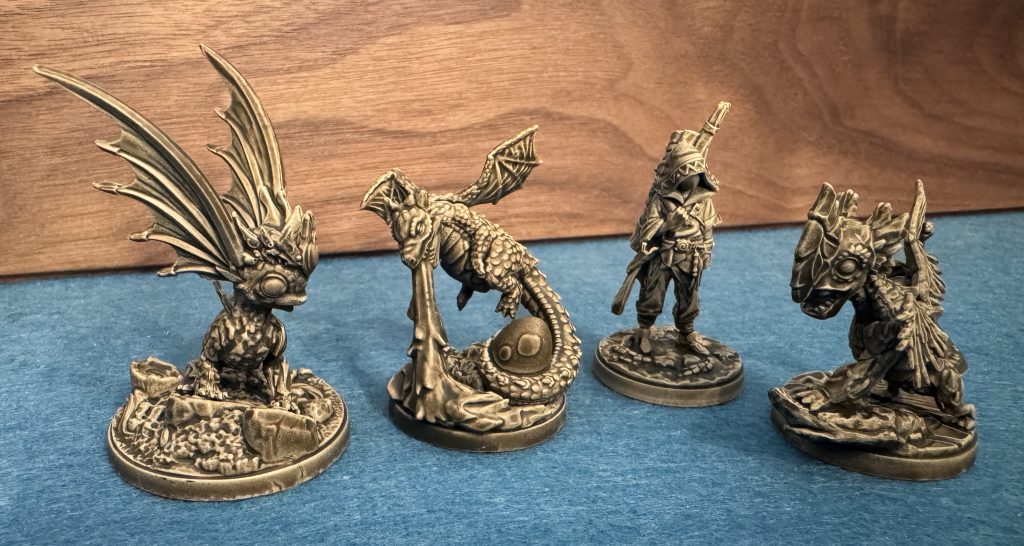
I really enjoyed my time with Dragon Eclipse. The Mystlings themselves are the hook. Each has a distinctive design, plays differently, has a distinct card pool, and you can develop their decks to match your personal playstyle. The split between the Adventure phase and Combat phase gives each session a satisfying rhythm, and the reveal of new cards for deck construction is an exciting reward to look forward to. My only concerns are the story having some lackluster moments, and a couple sudden spikes in combat difficulty.
Current Status: Useful Gear (Want To Play Again)
Overall, Dragon Eclipse is a standout adventure game with the insatiable creature collecting hook that Pokemon popularized. I’d recommend it to fans of narrative campaign games, collective card games, and any player who wants to tame fun, wild, and unique creatures.
⬇️ Keep reading for my full thoughts ⬇️
Initial Observations
I had already played Castles of Burgundy: Special Edition before I learned about Dragon Eclipse, which gave me a sense of what Awaken Realms does well: grand gaming experiences with eye-catching components. Dragon Eclipse was pitched as an excellent solo campaign that excited both my inner Pokemon trainer and card gamer. The promise was that you are not just fighting alongside your Mystlings, but you are taking them on a journey to learn about the game world. And the game definitely delivered on that promise.
I backed Dragon Eclipse on Gamefound in 2023 and received the Standee Edition with expansions. Soon after receiving my pledge, I sold my collection to upgrade to the Special Edition, which includes acrylic elemental markers, sundropminiatures in place of cardboard standees, sealed foil booster packs, and a Mystling Encyclopedia binder. My collection also included:
Dragon Eclipse: #NoMystlingLeftBehind expansion
Dragon Eclipse: Foray into the Shadow Realms expansion
Dragon Eclipse: Young Luminesca expansion
Untamed Arena expansion
Special Alternate cards created by Karolina Margielewicz
Dragon Eclipse: Mystling Feat Promo Cards
Terrain miniature pack
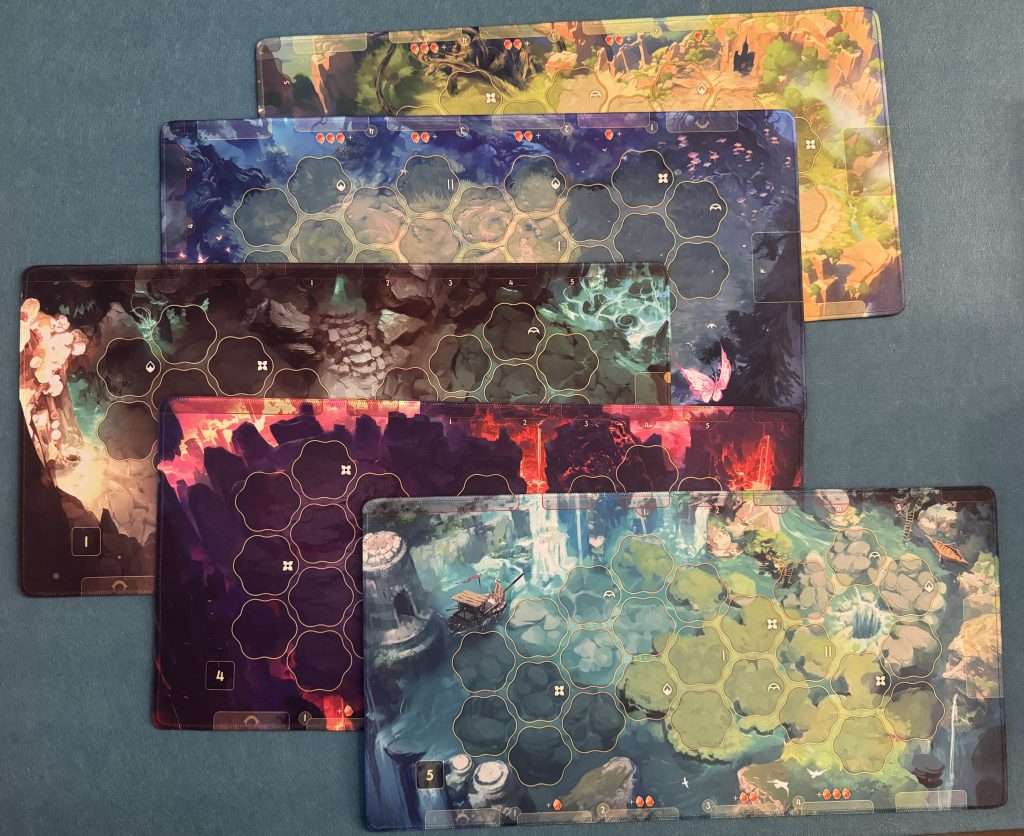
Arena playmats set
Combat Deck Box
Gameplay
At first glance, the inside of Dragon Eclipse looks daunting. The game ships with a Start Here booklet for good reason. Before you read the rulebook to learn the rules, Awaken Realms asks you to spend thirty to forty minutes simply organizing the game’s cards and components. And if you like to sleeve your cards like me, then expect this process to take much longer. That time investment pays dividends later, but I want to be honest: the setup overhead is real, and it will test your patience before you’ve played a single turn.
Once you’re past that threshold, Dragon Eclipse reveals itself as something genuinely special.
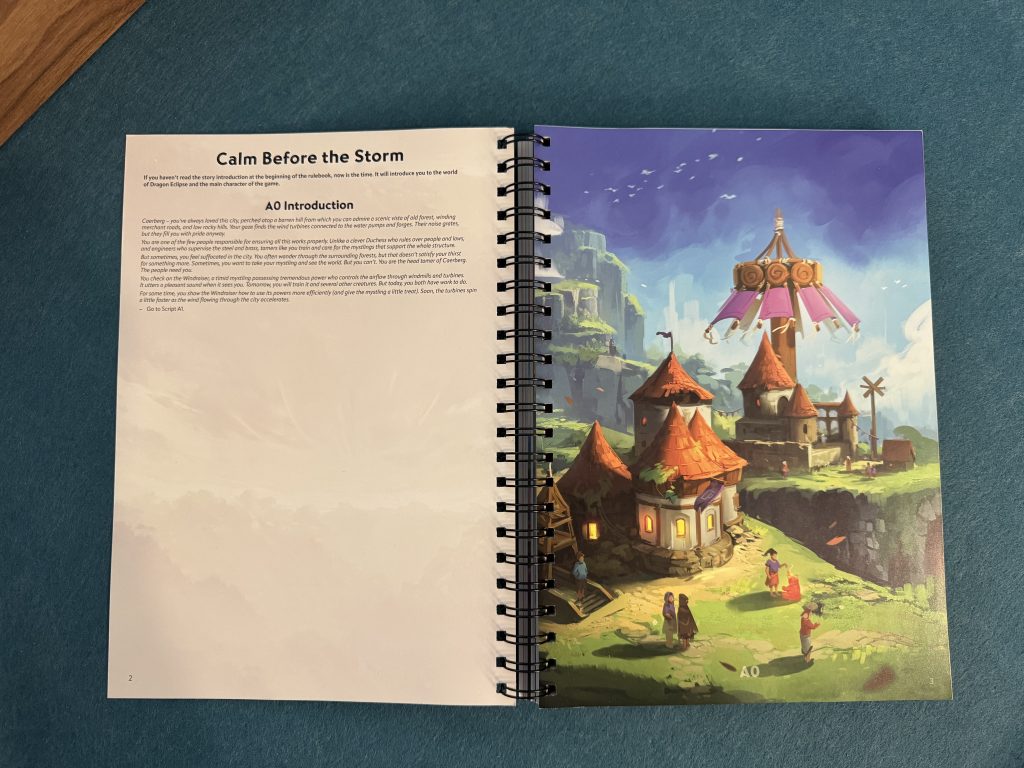
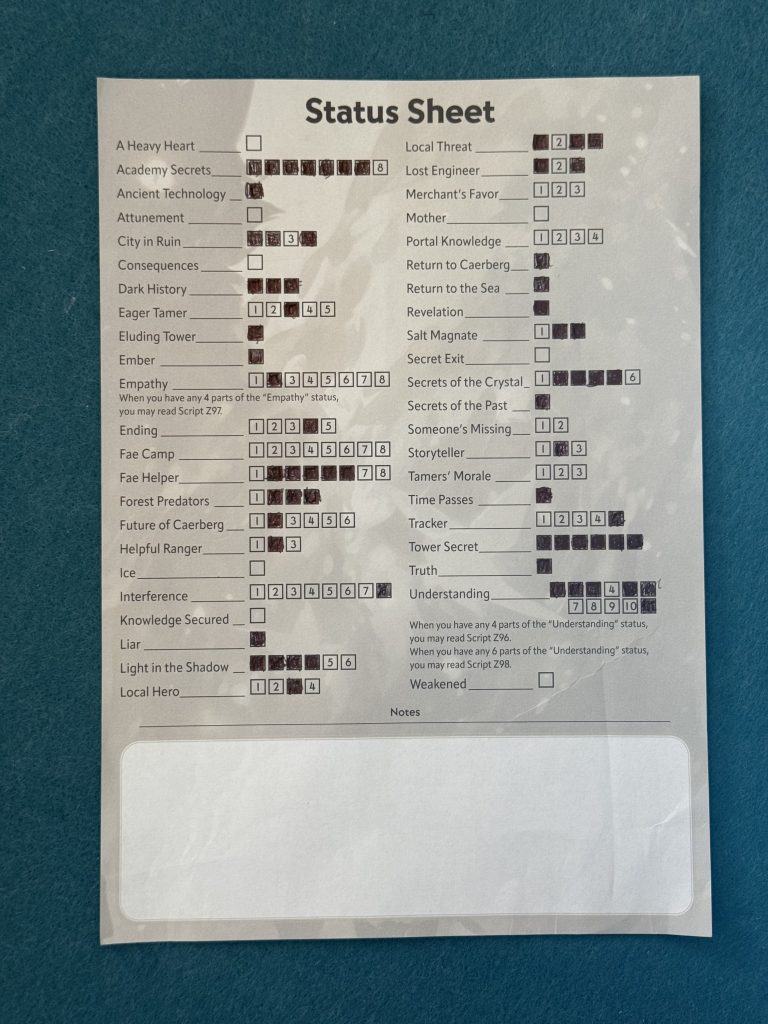
Each game session starts Before the Scenario. You navigate a World Map made up of small cards representing the location you’ll choose to visit next. You’ll unlock new locations to explore as you progress through the campaign. The Adventure Journal, a book that functions as the game’s narrator and storytelling engine, guides you through the whole experience. Think of it as a choose-your-own-adventure book. And thanks to the assistance of the Status Sheet, a single-use document that marks key moments on your journey, the Adventure Journal knows where you’ve been and what decisions you’ve made.
The Adventure phase is where you spend most of your time during a Scenario. You explore maps in the Location book by selecting different Scripts to read from the Adventure Journal. This represents you visiting sites and interacting with characters. These moments include making decisions that will branch the story in ways you won’t fully feel until two or three Scenarios later. Pro Tip: Keep an eye out for hidden scripts on the Location map that will provide some surprise and secret storylines.
The Location maps often have a Time track that limits how much time, or how many Scripts, you can read during a Scenario. This gives a sense of urgency and acts as a reminder that you may not have time to accomplish everything available. Fortunately, you often know how much time actions will take and can plan accordingly. Additionally, some maps have numbered and/or lettered Slots that will track your decisions throughout the Scenario and mark changes in the story. Maybe you’ve spoken to an important person or completed a quest, this will be marked on the Location map and might even lead to scripts becoming locked or unlocked.
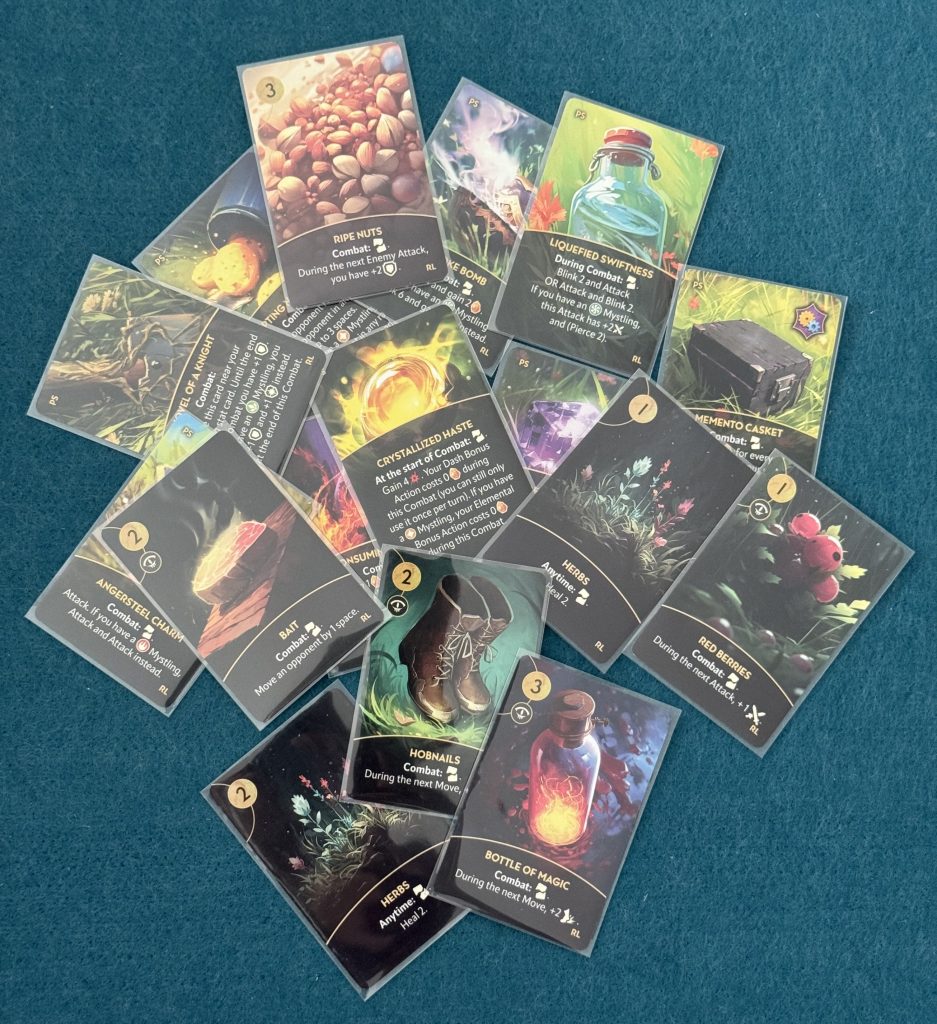
To add to the challenge, some scripts involve completing tests, but this isn’t something you can study for. Instead, you use the item deck to flip cards in a push your luck minigame. You can also separately find, purchase, and be gifted these item cards along with stronger equipment cards that may modify your test outcomes. Different outcomes will affect where you go in the story but know that sometimes you can get a positive story outcome, but still face a penalty. Be careful!
The Combat phase is where the game’s mechanical depth lives. As a Tamer, you will always have two Mystlings by your side, each with their own 16-card action deck that you’ll construct prior to the start of the Scenario. Combat is turn-based and uses a unique system that always displays four of your Mystling’s action cards on the board serving as this game’s version of a hand of cards. On your turn, you resolve one of the four available action cards, gaining the Mystling energy resource known as Power and triggering the action card’s effect. The action card’s position in the four slots also matters. Some effects scale with position and others activate only in specific slots. As your Power accumulates across turns, you will gain access to bonus actions and eventually your Mystling’s Special Ability, a powerful move unique to each creature.
On the enemy side, your opponent Mystling draws and resolves attack cards from its own deck, and you always know which card is coming next. That transparency is a deliberate design choice, and it works beautifully. You’re not reacting to random chaos, instead you’re solving a puzzle under pressure. And knowing what’s coming next doesn’t make the battles easier. Enemies have special abilities and, in general, higher stats than your Mystlings. Additionally, the two-player campaign introduces a targeting system that can make predicting the enemy’s moves all the more challenging.
Positioning matters across the hex-based arena. Attack ranges, movement abilities, elemental advantage, and arena-specific setup rules all contribute to a tactical layer that rewards attention. The arena maps change from Combat to Combat, and some come loaded with terrain that can act as environmental hazards or one-time use boons. No two Combats play out the same, even against the same enemy.
The most exciting Combat phases are those which offer the chance to tame the enemy Mystling. Taming requires you to fulfill a series of conditions in a specific order such as inflicting a specific amount of damage in a single turn, reducing the enemy’s health below a target threshold, or ending your turn on specific arena hex locations. If successful, you’ve won the battle and gained a new Mystling ally!
The final step of a game session is the After the Scenario phase which is more than a clean up step. Upon reaching the end of the Scenario, you will gain access to new World Map locations, open Booster packs with powerful new action cards, expand your collection of Advancement cards, heal your Mystings, and have the opportunity to save your game.
Field Testing and Replayability
The opening Scenario feels like it’s designed to immediately let gamers know if this experience will match their interests. While echoing tropes from Pokemon games, you start in a town, get introduced to your starter Mystling, and embark on a quest to save the world. You quickly learn about branching adventure paths, mysteries, battles, and the important fact that your decisions affect and change the world around you.
I quite enjoyed the rhythm of exploring a map, learning about the world, and solving puzzles before a Combat phase where I might have the chance to tame a new Mystling. I also found the deck construction element to be satisfying. The 16-card deck requirement starts to feel challenging as your card collection grows, but I enjoyed searching for combos that match my Mystling’s playstyle. Thinking about how to use special abilities while gathering enough Power all while ensuring you have the necessary cards or resources to move around the map and attack is what makes both the deck building and Combat phase fun. Each slot in your deck is meaningful and impactful.
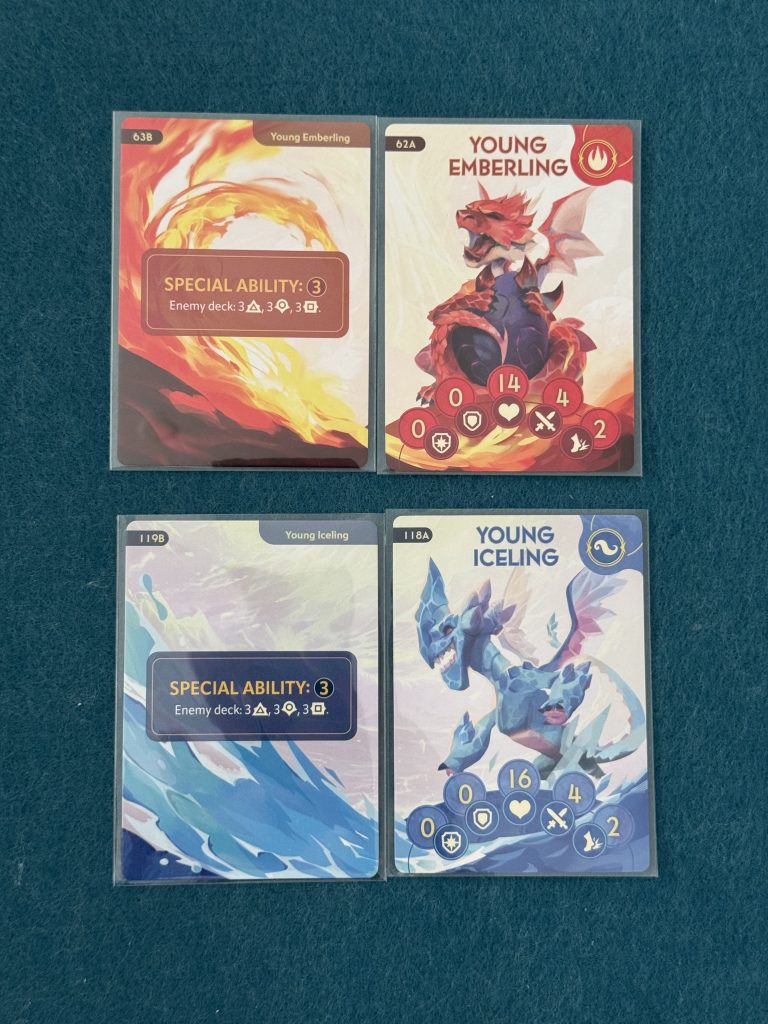
The wide array of Mystlings were cool to discover as well. Plenty of elemental dragons, which isn’t surprising given the name of the game. The Mystlings have a distinct style to them that makes the game feel like a cohesive world while still allowing for both cute and aggressive designs. The fact that some Mystlings can change form adds an additional element to broadening your collection and strengthening your team. And as you tame new Mystlings throughout the campaign, your strategic options multiply.
Full disclosure, I never tried the Roguelite mode, which is available for both solo and two players. It takes the form of consecutive boss fights. I like the idea of using your Mystlings outside of the campaign and testing new deck builds, but I purchased this game with a strong interest in the storytelling elements of the main campaign. There is also a Player versus Player (PvP) mode. While I never tried the PvP mode either, I think this makes the most sense as an added feature to have for casual battles with your unlocked Mystlings and Action cards. PvP really leans into the collective card game nature that helped inspire Dragon Eclipse.
Despite enjoying my time with the Dragon Eclipse campaign, this game has left my collection purely for logistical reasons. Space constraints in my growing board game collection and the time investment required to run through the campaign again affected my decision. In an ideal world, I would continue to enjoy it and build new decks for my Mystlings and hone my skills as a Tamer.
Notable Discovery: The Adventure Journal
The Adventure Journal is the piece of Dragon Eclipse that most surprised me. I expected it to function solely as a script book, a numbered list of passages you look up and read aloud. It does that, but it does considerably more. The Adventure Journal tracks your decisions by placing tokens on the Location maps, locking and unlocking Scripts based on statuses you’ve accumulated across sessions, and occasionally presents choices that feel genuinely consequential.
What impressed me most is how the Adventure Journal manages information. You often encounter a passage that refers to a status or token you placed earlier, sometimes even multiple Scenarios earlier. The game remembers, even if you almost didn’t. It gives the campaign a sense of authorship like the world is reacting to how you’ve moved through it and adjusts accordingly.
The only practical friction: the scripts in the Adventure Journal are not ordered in narrative order so you have to flip back and forth quite often to read the next passage. While a mild annoyance, it is useful to avoid reading ahead and spoiling yourself on what’s next in the story.
Notable Discovery: Booster Packs
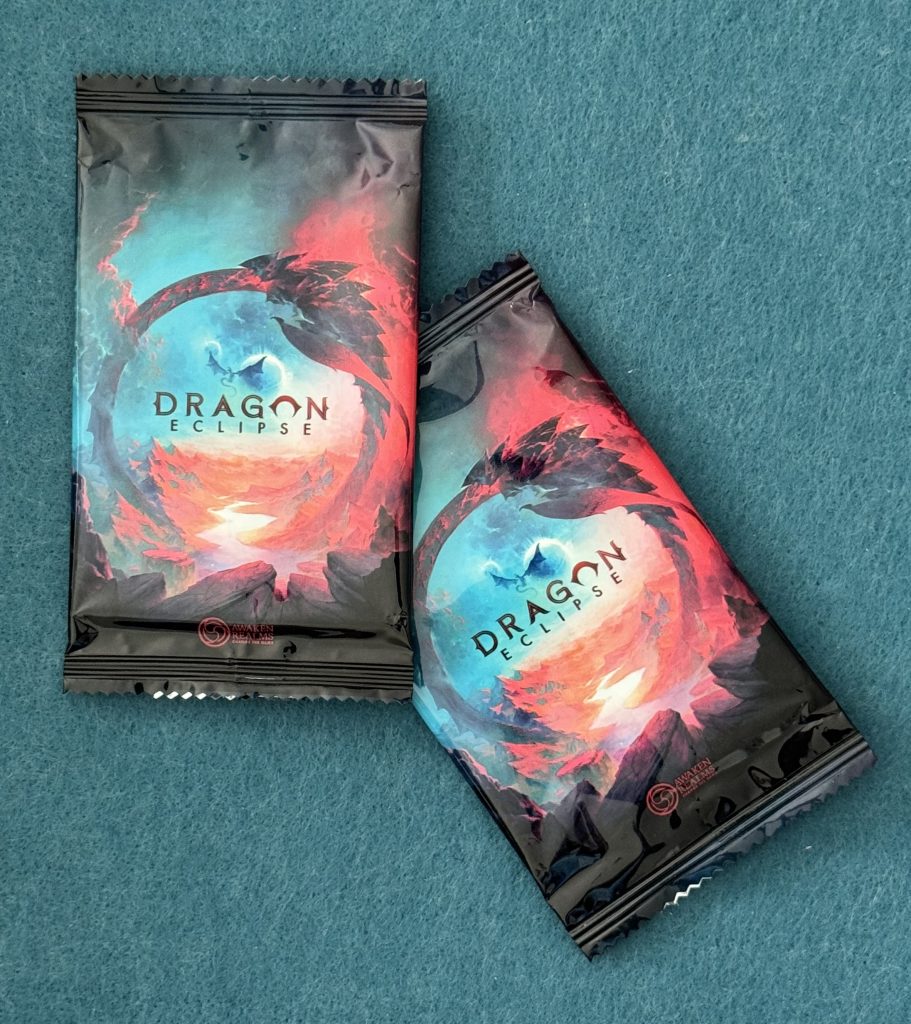
This game is just as much about cards and deckbuilding as it is about adventuring and monster taming. At the end of each Scenario, you will unlock new cards through booster packs. If you own the special edition, these packs are sealed in a foil wrapping just like Pokemon or Magic the Gathering cards. If you purchase the standard edition, your booster packs will consist of sets of cards sorted into paper envelopes.
When you open a random booster pack, you’ll receive new and powerful cards of each element that go into your unlocked card pool for future deck construction. And just like popular collectable card games, Dragon Eclipse cards come in different rarities ranging from Common to Legendary. The Legendary cards are not only holographic, rare, and powerful, but are limited to one copy of each in the game and are so impactful that you are limited to one Legendary card per deck.
Fortunately, you will never have bad pulls because the booster packs are predetermined. You might not know which one you’ll open, but the game includes a list of cards available in each pack so you can reset the game. Some might be frustrated with the randomness, but I find it exciting to receive random packs that open up new combat strategies, novel effects, and unlock synergies with Mystling abilities.
Observer’s Notes
A word on the unboxing and organization challenge, because I don’t think it gets enough attention in the conversation around this game. The “Start Here!” booklet walks you through it step by step, and following it carefully makes an enormous difference. The giant stacks of Mystling cards, secret cards, and actions cards are intimidating. Therefore, the included card dividers are essential and functional, not decorative, and using them correctly from the start will save you significant time later. You’ll often need to grab secret cards, item cards, equipment cards, Mystling cards, and Combat cards during a Scenario and you’ll appreciate when they are organized and accessible, hence why I am happy with my purchase of the Awaken Realms card sleeves box. Another requirement for gamers who sleeve their cards, because the insert is not designed to hold sleeved cards
Field Report Summary
Current Status: Useful Gear (Want To Play Again)
Rules Accessibility: Dragon Eclipse includes a “Start Here!” booklet that handles the component setup, and all the instructions needed to start your journey. This approach eases you in comfortably to using the Adventure Journal, performing tests, and completing combat. There are Advanced Rules used in later scenarios that are easy to find in the Rulebook when you’re ready for them.
Replay Potential: The campaign structure makes each session feel different. And between the branching story paths, random Booster envelopes, hundreds of Actions cards, and a large Mystling roster, you can easily have different experiences between full playthroughs. Plus, there are expansions, a Roguelite mode, and PvP combat to extend the game’s shelf life.
Components: The Special Edition acrylic tokens and miniatures add to the table presence and immersive experience. The card quality is solid with fun art on the Action cards, however, some of the item and equipment cards have lackluster designs. The Adventure Journal is serviceable while the Location Maps are colorful, detailed, and beautiful.
Time Investment: The initial unboxing takes 30+ minutes, at least for the Standard edition, as there are a lot of cards to sort through and organize. Subsequent setups are fast and you can dive right into each Scenario easily by pulling out decks of cards from behind the included dividers. Each Scenario runs 1-2 hours once you are comfortable with the rules.
Portability: This is a big game with a lot of cards and potentially a lot of miniatures. If you have the Special Edition, I would not consider this a portable game.
Recommended Player Count: I think both the solo or two player modes are satisfying. The two-player rules allow each player to control a Mystling during combat, and share decision making responsibilities during the Adventure phase. I think both modes are satisfying.
Artists: Jiří Kůs, Jiří Mikovec, Jakub Politzer, and Ondřej Hrdina
Publisher: Czech Games Edition (CGE)
Player Count: 1-4
Estimated Play Time: 30 minutes per player
Box Size: 11.75” x 11.75” x 3”
Quick Debrief
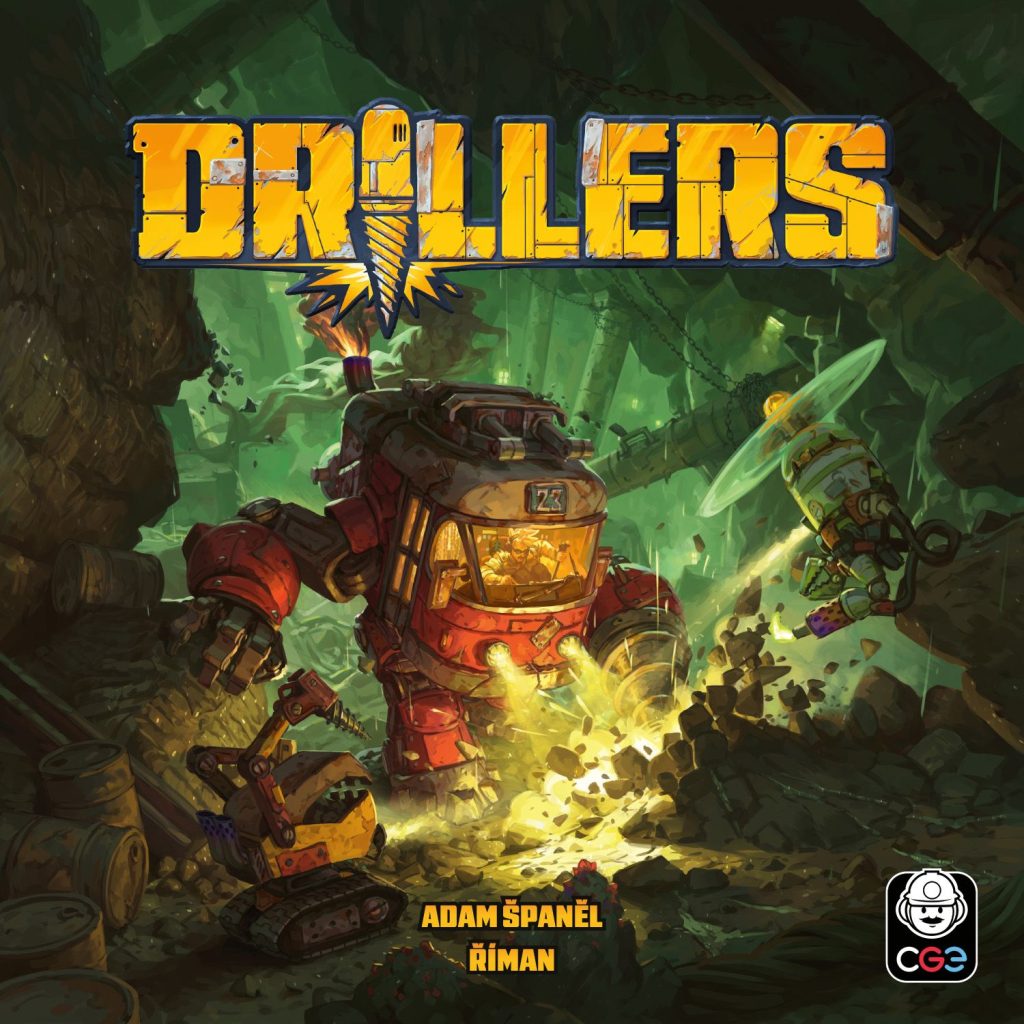
This competitive deck-building game takes one to four players into an abandoned mine and tasks them with drilling, exploring, and collecting minerals to earn the most victory points. Each game will reveal a variety of different cards as players move through three phases: Operations, Surfacing, and Upkeep. You’ll need to customize your deck to give your mech the power and features needed to dive deeper into the mine and collect more valuable minerals and Mine Tiles.
Drillers is an instant favorite. The fun art and solid deck-building mechanics captured me during my first game. The ease of setup, the comfortable playtime, the face-up deck mechanic, satisfying combos, and the Drone Tokens are all highlights for me. There is also a great sense of tension as you weigh your options between staying inside the mine, racing for victory points, and strengthening your mech’s capabilities. I expect CGE to support and expand this game as a new flagship franchise.
Current Status: Essential Equipment (Must Own)
Overall, this is an excellent addition to my collection of deck-building games and offers some unique twists with a quirky, amusing theme. I’d recommend this game to fans of Lost Ruins of Arnak as well as deck-building games with quick turns. And if you really like mining and custom mechs, this also might catch your interest.
⬇️ Keep reading for my full thoughts ⬇️
Initial Observations
I have been a huge fan of Lost Ruins of Arnak to the point that I quickly went from owning just the base game to filling the Adventure Chest with expansions and promo cards. And thus, CGE immediately caught my attention when they announced a new deck-building game. Mining with customizable mechs and racing for victory points from Mine Tiles was enough to get me to preorder in April 2026.
I ordered Drillers along with the Upgraded Components and received the Omnidrone promo card as a preorder bonus.
Gameplay
Drillers combines many popular deck-building mechanics with some fun twists and thematic elements. The game is a race to collect the most victory points and become a Driller of Legend. Every player will start with the same deck of nine cards, many of which are worth negative victory points at the end of the game and represent the cobbled together assortment of scavenged parts used to build your mech. Once players have excavated the minerals, corridors, and floors, the mine will reach its critical limit and the game ends as the mine collapses. Hopefully, your mech isn’t still inside the mine, because you will lose victory points if you don’t escape before the collapse.
Each turn is divided into three phases: Operations, Surfacing, and Upkeep. Players will always have the opportunity to complete the Operations and Upkeep phase. If a player’s mech is on the Surface at the end of the Operations phase, they will conduct the Surfacing phase.
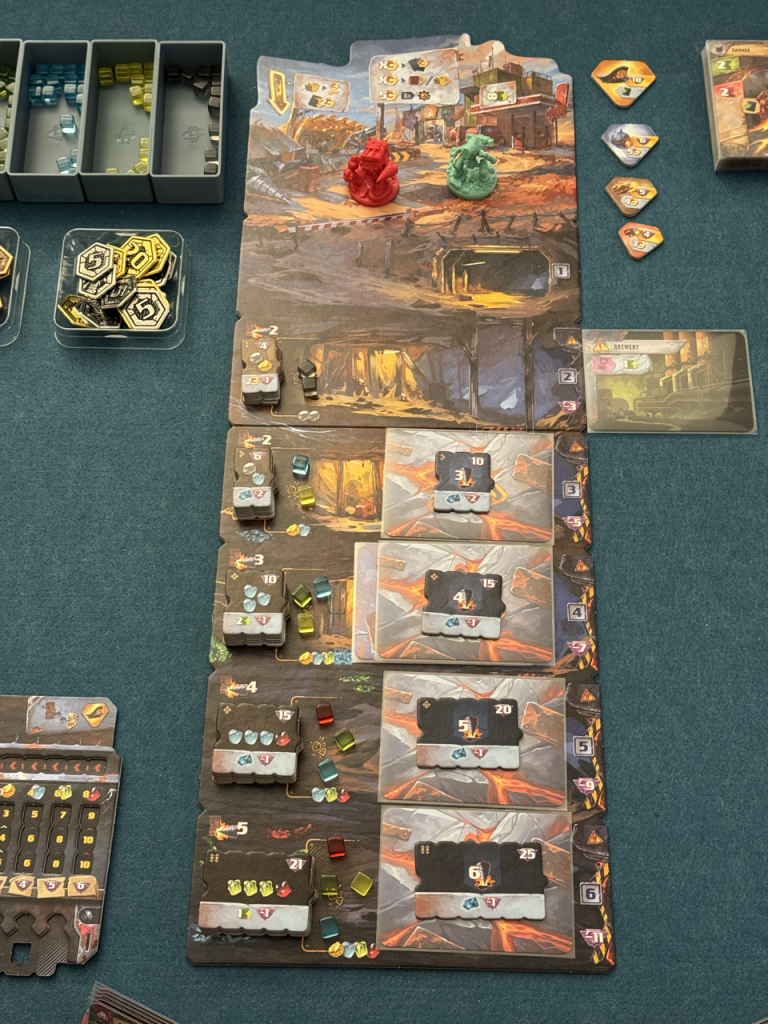
Drillers’ Main Board
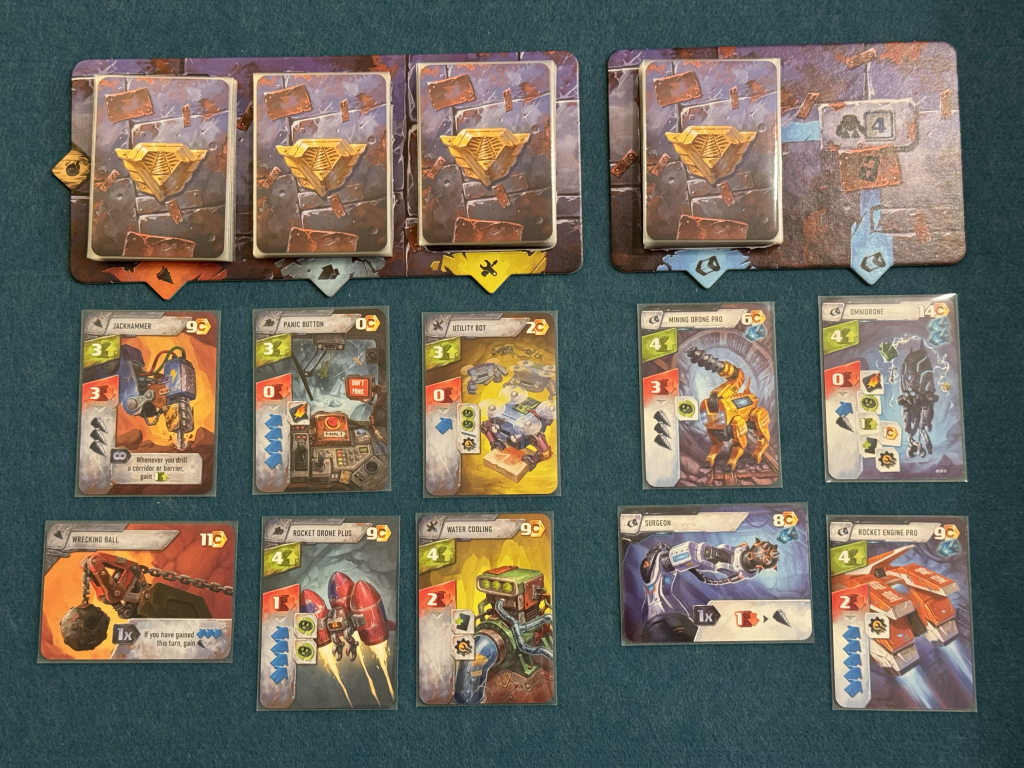
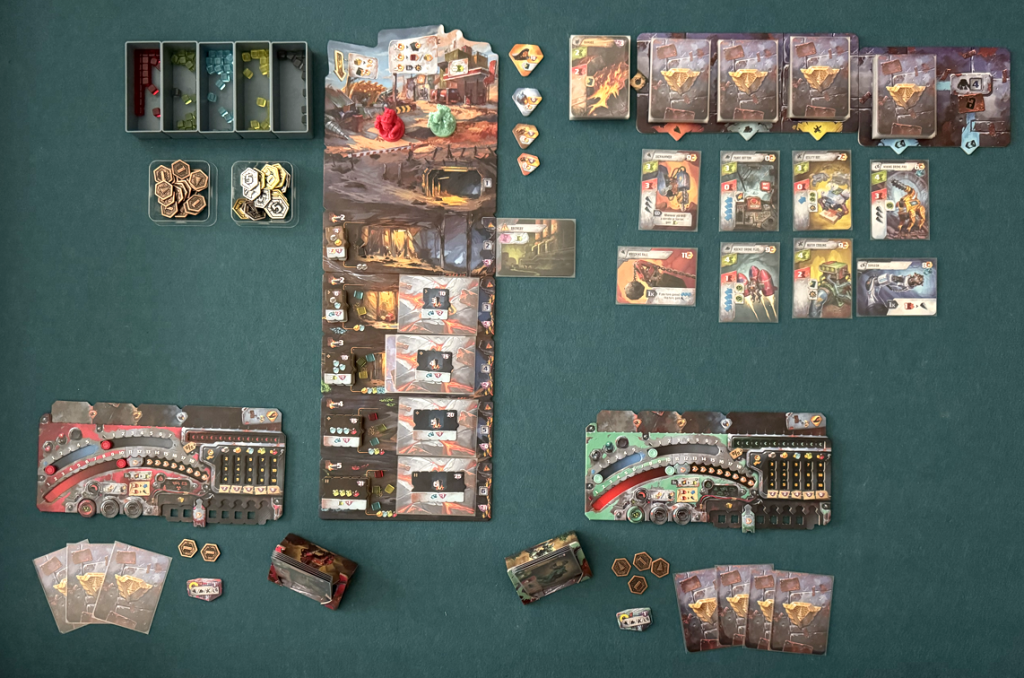
The Operations phase feels similar to many deck-builders in my collection such as Lost Ruins of Arnak, Star Realms, or Marvel Legendary. You can play your cards from your hand, one by one, in any order. Cards can be used two different ways: generating fuel (the main resource for playing cards) or burning fuel to activate special effects. You will need to manage your fuel gauge as you play cards for Movement and Drills. These two resources only last until the end of your turn, so you must use them wisely. Movement allows your mech to move between the Surface and different floors of the mine, and Drills help you collect minerals, carve out new corridors, or break barriers to lower floors. As you upgrade your deck with new cards, you’ll have access to more fuel efficient and powerful abilities. New cards also provide you special effects, like the ability to upgrade minerals to their more valuable counterparts.
In addition to playing cards, your mech has a few other abilities like basic movement and drilling functions as well as Drone Tokens. While in the mines, you are too far away from the shops on the Surface, but you can send a Drone upward to sell minerals and buy new parts for your mechs. Your Drones are a limited use resource that will need to be refreshed if you want to stay in the mines longer while still collecting credits and upgrading your mech.
You can even intentionally damage your mech for more fuel. This could lead to negative victory points at the end of the game, but will allow you to push your mech harder down in the mines!
A key component of the mines are the Floor Cards and Mine Tiles. Each floor will have a randomly assigned card changing up the rules with mandatory effects that activate on reveal, when excavating a corridor, when collecting a mineral, and/or ending Operations. The Corridor Mine Tiles and Barrier Mine Tiles are worth varying victory points and change up the game by adding new minerals to each floor or opening up the mine to deeper levels. Like the Idol Tokens in Lost Ruins of Arnak, the Mine Tiles are worth a set amount of victory points, but you can flip them over, reducing the victory point value in exchange for bonuses like blue batteries that power upgraded cards’ special abilities, card draws, and credits. The final tiles you can collect are achievement tiles. Players earn them by racing across their Progress Tracks. The recipient earns victory points while providing a resource bonus to all other players. This provides Drillers with an elegant catch-up mechanic to prevent one player from gaining too big of a lead in victory points.
The Surfacing phase only occurs when you complete your Operations phase with your mech on the Surface. This unique twist along with the Drones forces you to decide when to sell minerals and spend credits on new cards versus seeking out more victory points in the mines. In Drillers, the upgraded cards you purchase at the shops aren’t worth victory points at the end of the game, but they are necessary if you want to accomplish more in the mines. Additionally, unlike the usage limits on Drones, while on the Surface, you can sell all of the minerals in your storage at once and buy as many cards as you can afford. Among the card shops, there are Advanced Technology cards, representing tech leftover from whatever corporation originally built the mine. A blue battery, only found on Mine Tiles, is required to purchase and power the Advanced Technology cards, accessing a whole new range of powerful abilities!
Card Shop Decks
The final benefit of coming to the shops is that you can refuel your mech for free, upgrade your fuel and mineral storage for a fee, and repair your mech for a fee. Repair is this deck-builder’s version of trashing or removing unwanted cards from your deck. Because most starting cards are worth negative victory points, you’re incentivized to repair them out of your deck and replace them with cards from the different shops. And because the shop decks are organized by card type, you’ll always have access to cards that offer specific advantages you may need such as more Drills, more Movement, Drone refreshing, or Repair actions.
The final phase of a turn is the Upkeep phase. This is a pretty standard board game phase where you decide if you’ll keep unplayed cards in your hand for the next round, move played cards to your discard pile, draw three new cards, and refill the card shops. The fun part of Drillers is that there is no hand size limit so you could keep all the cards in your hand (if you have enough fuel) to build up for a big turn on the next round. And because you always draw three cards, you can plan ahead by buying specific cards, which will go on top of your deck.
This cycle continues until someone has retrieved enough Mine Tiles to fill their Progress Track and trigger the end of the game, then every other player will have one last turn before the Driller of Legend is decided.
Field Testing and Replayability
I’ve played against the solo bot, against one other player, and against two other players. And I really enjoyed each player count. They all feel different and I felt like I used a different strategy each game.
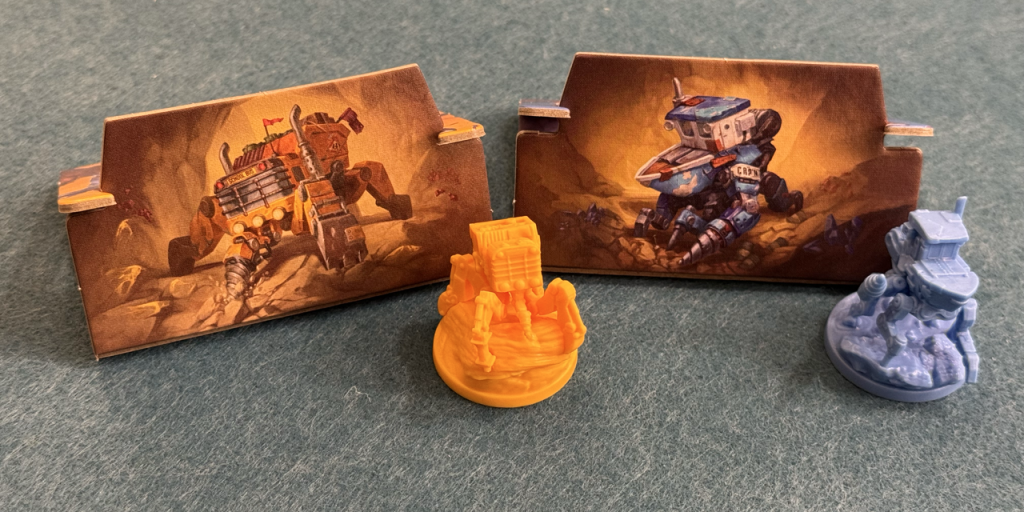
Headmaster and Splash Mech Miniatures
An aspect of the solo mode that I enjoyed the most was the bot’s ability to clear cards from the shops. While there were some frustrating moments when a card I really wanted was wiped before I could purchase it, it was fun having a built-in mechanic to circulate new cards in and out of the shops. One of the novelties of a deck-building game is the various cards and their abilities, and the Corporate Bot aids in seeing more of the shop decks.
While this is a competitive multiplayer game where you race for the most victory points, I appreciate that this game doesn’t feel mean or combative. You will certainly take a card or Mine Tile that another player wants, which can lead to some mild frustration, but I like that this is a game where I can happily watch another player pull off card combos. Seeing any player drill, collect, and sell multiple minerals in a single turn and still have the resources to buy a fancy advanced card is exciting.
Drillers has a casual, exploratory vibe where I feel comfortable applauding impressive actions and I don’t feel like I’m shut out from doing the same thing on my turn. In fact, the player interaction with the Mine Tiles is important because removing Barrier Mine Tiles opens up floors with more valuable minerals and collecting Corridor Mine Tiles releases a pool of minerals for the next player to snatch up.
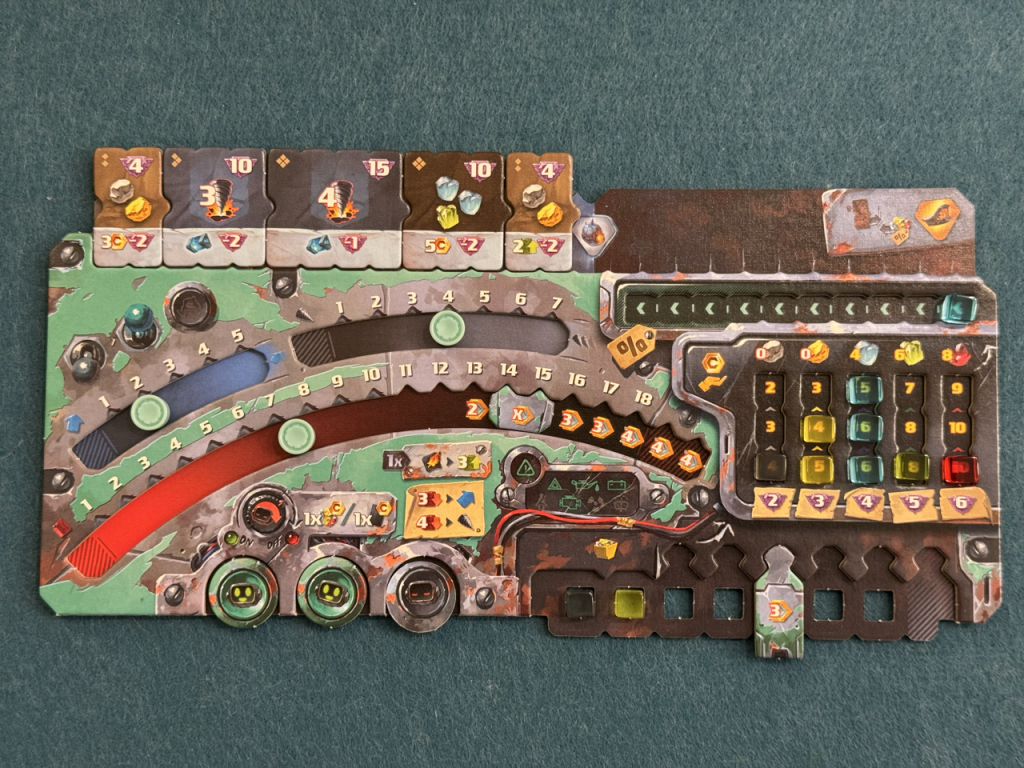
Player Dashboard
I think the shop decks are large and varied enough that every player has the opportunity to purchase something cool and useful. The permanent cards are especially cool because these horizontal cards are never added to your deck and instead are placed next to your dashboard providing reliable effects each Operations phase. And there are enough corridor tiles, that you won’t be blocked from drilling some yourself. There is still a satisfying sense of tension in this game. Especially when it comes to racing to be the first to drill through a Barrier Mine Tile to open access to a new floor. Racing to complete your Progress Track with Mine Tiles and collect milestones gives this game the perfect balance of feeling competitive without being stressful.
The last aspect that I enjoyed was the variable game length. The number of rounds and turns will vary from game to game. It was around what ended up being two-thirds through a game that I felt like players were met with the question of pushing to end the game early or continuing to collect minerals and credits. Like a lot of clever game designs, you can only delay the end game trigger for so long before you reach a tipping point where it only takes one more Mine Tile or mineral sale to end the game and collapse the mine.
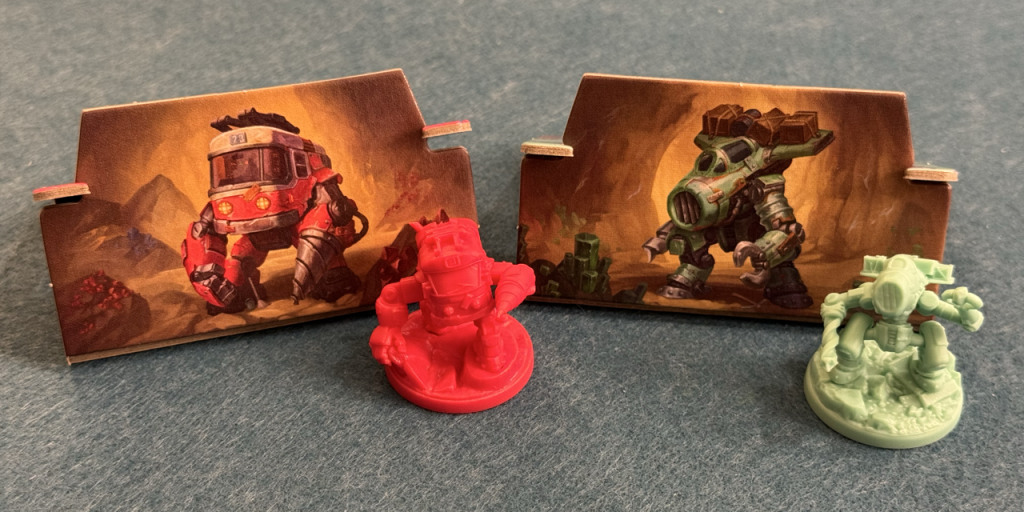
Railbreaker and Mayday Mech Miniatures
After each game of Drillers, I find myself thinking about what I want to do differently the next time I play.
Notable Discovery: Face-up Deck
Most deck-building games require you to remember which cards are in your deck in order to guess when you might draw the card you want. Different games have incorporated rules like placing new cards on top of your deck so you know what you’ll draw next. Other games provide foresight by avoiding shuffling so you can remember the order of cards played and the order they’ll come back. Drillers switches up the format by having your deck of cards face-up the entire game. There is even a cardboard stand to keep your deck facing you and hidden from other players.
Drillers Card Stand
I didn’t think always knowing the top card of my deck would make much of a difference, but I often found myself using that knowledge to plan my current and next turn. Do I want to play a card that will let me draw that face-up card staring at me? Do I recognize I can’t accomplish much this turn but could if I wait until my next turn? Adding purchased cards to the top of your deck also feels more impactful because I know the card underneath. The strategic depth is simple and satisfying.
Notable Discovery: Drone Tokens
The Drone Tokens provide a unique strategic element to the game. You can easily build a deck around keeping your Drone Tokens active which can allow you to stay in the mines longer to collect valuable minerals. With enough fuel, storage, and Drones, you can sell minerals for credits, buy new cards to upgrade your mech, and stay inside the mine drilling for valuable minerals and Mine Tiles all without going back to the Surface for several turns. This isn’t always easy to pull off, and may not lead to victory, but it is certainly a fun and interesting strategy!
Observer’s Notes
Before my first multiplayer game, I asked my partner which mech they wanted and they asked if they had asymmetric powers like the Expedition Leaders in Lost Ruins of Arnak. I think it’s worth noting that the base game is fun, has lots of room to explore different deck builds, multiple avenues to gain the most victory points, AND, in my opinion, has built-in room for expansions. The mechs could have unique powers, the shop decks can be expanded with more cards, new effects could provide variety on Floor cards, and there could be a new game board with a different mine layout. I’m left feeling excited for the future of this game.
Full Game Setup
Field Report Summary
Current Status: Essential Equipment (Must Own)
Rules Accessibility: The rulebook is easy to follow and the three-phase structure allows for ease of understanding and teaching the rules. The added player aids are helpful for remembering the flow of a turn. I also found cards with special effects to be easy to interpret. I appreciate the clear reminders for unique effects that can only be performed once per Operations phase versus effects that can be performed any number of times in a turn.
Replay Potential: Between the Floor cards, shop decks, and corridor Mine Tiles, there is enough variability to keep the game fresh and fun after dozens of plays. After a few games, you may have a few favorite cards that you’ll seek out, but you’ll never know when they might become available. Additionally, even if you remember all the Floor card effects, you can never fully prepare for them.
Components: The dual-layer player dashboards with sliding gauges are thematic and provide a pleasing tactile element. It’s also rewarding to collect minerals on your dashboard as you drill and sell. The art is colorful and vibrant, and the quirky approach to mechs and upgrades is cute and amusing. I especially love the upgraded metal credits with engraved drilling-themed faces. However, I am slightly worried about the long term durability of the deck card stands which are relying on friction to hold their shape.
Time Investment: The publisher’s estimate of thirty minutes per player is accurate. A solo game might take a little longer as you puzzle your way through optimal turns, but it won’t drag. There is room for analysis paralysis or AP, but you typically have a smaller hand of cards in Drillers than other deck-building games which will limit players from getting too overwhelmed with decisions. But the range of choices on a turn can quickly grow with the addition of Mine Tiles, permanent cards, and drone tokens.
Portability: This game is very portable with a moderate-sized game box. The game doesn’t weigh very much and can easily travel with you to your next game night.
Recommended Player Count: Two to four players. I really enjoy the solo mode, but I think the game shines best with more players. The race to collect Mine Tiles and minerals and the tension of wondering if another player will buy the card you want from the shop all adds to the fun. Additionally, more players means the mines will evolve faster as corridors are drilled dropping new minerals and new floors are explored as players aim for big victory from Barrier Mine Tiles.
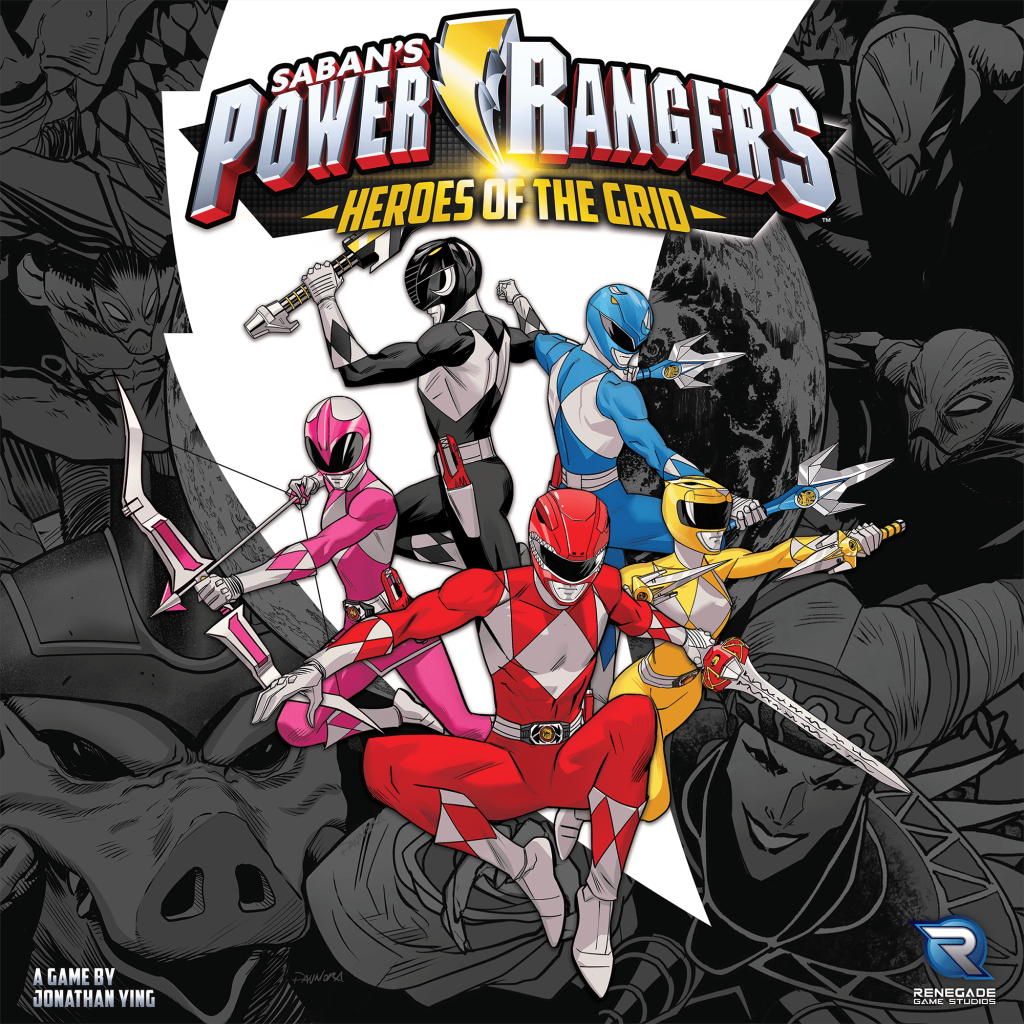
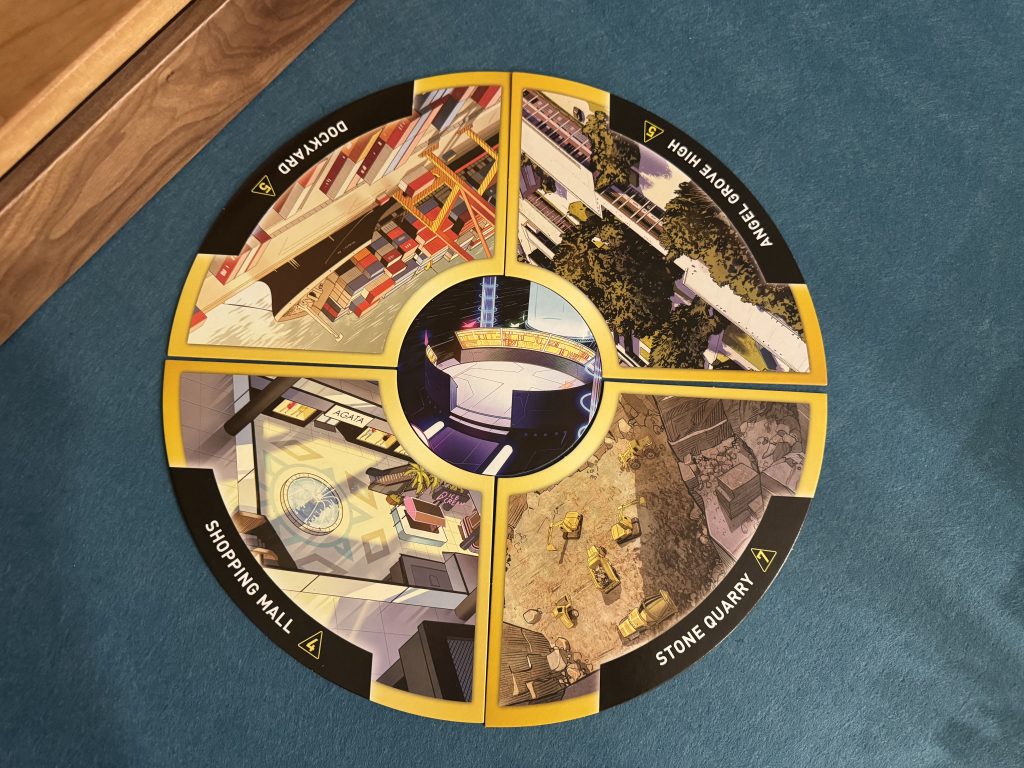
In this cooperative game, up to six players form a team of Power Rangers defending Angel Grove and various locations from the evil forces of Rita Repulsa and other bosses. Each round, enemies flood into the four outer locations surrounding the Command Center, and the Rangers spend their actions moving across the board to battle foot soldiers, monsters, and eventually, the final boss. Combat is resolved through a shared combat card system, in which each Ranger brings a unique ten-card deck to the table and the team pools their resources to fight their way through a sequence of enemy combat cards.
I’ve enjoyed Power Rangers: Heroes of the Grid over the years. The combat system is straightforward, easy to teach in minutes, and layered enough to generate genuine team-driven decisions. Each Ranger plays differently, the team coordination is satisfying, and the escalating pressure of watching locations creep toward panic creates the right amount of tension. My one ongoing frustration is the dice combat system. Damage output on the Ranger attack cards is determined by rolling dice, and the dice can be unkind with their rather low hit rate leading to turns that evaporate through no strategic fault of my own. It doesn’t break the game, but it sometimes tests your patience.
Current Status: Useful Gear (Want to Play Again)
Overall, I recommend this game to fans of cooperative games, and especially, of Power Rangers. A game session can run under an hour without sacrificing the feeling of a real tactical fight. If you can make peace with the dice randomness, there’s an opportunity for some genuinely exciting team-based moments. Simply put, if you’re a fan of Power Rangers, you are probably willing to give this game a shot.
⬇️ Keep reading for my full thoughts ⬇️
Initial Observations
Power Rangers: Heroes of the Grid is the game that started my interest in the modern board game hobby as well as crowdfunding board games. The Power Rangers franchise was a key part of my childhood and seeing the opportunity to take on the role of the original Mighty Morphin Power Rangers with friends was a huge selling point.
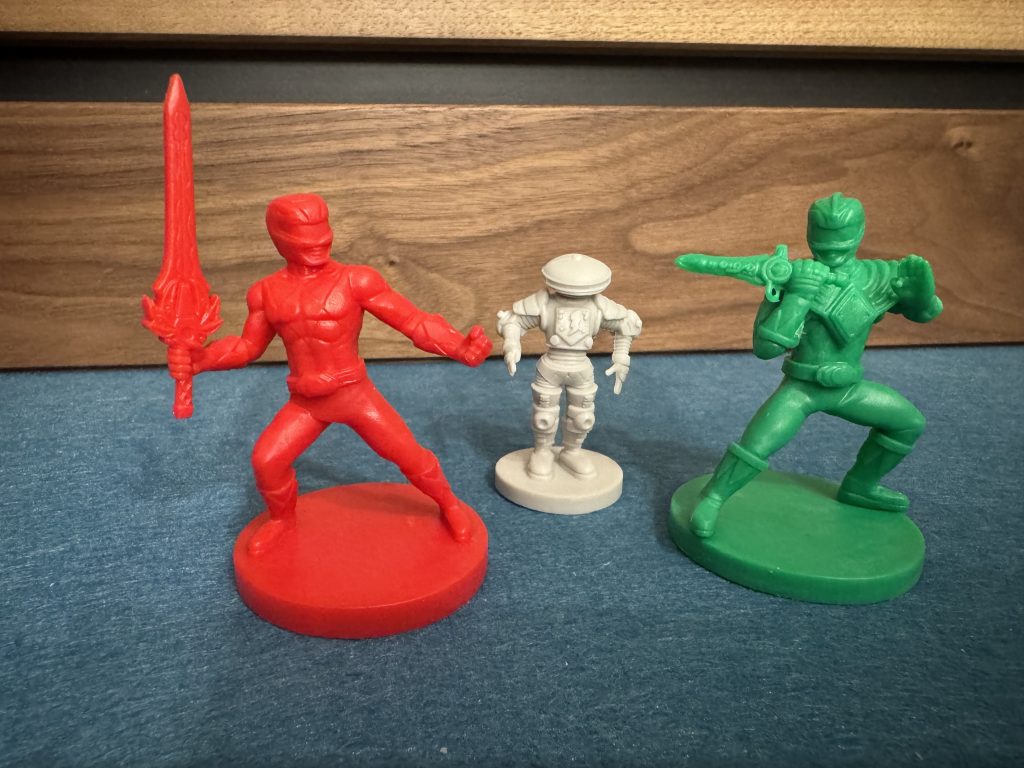
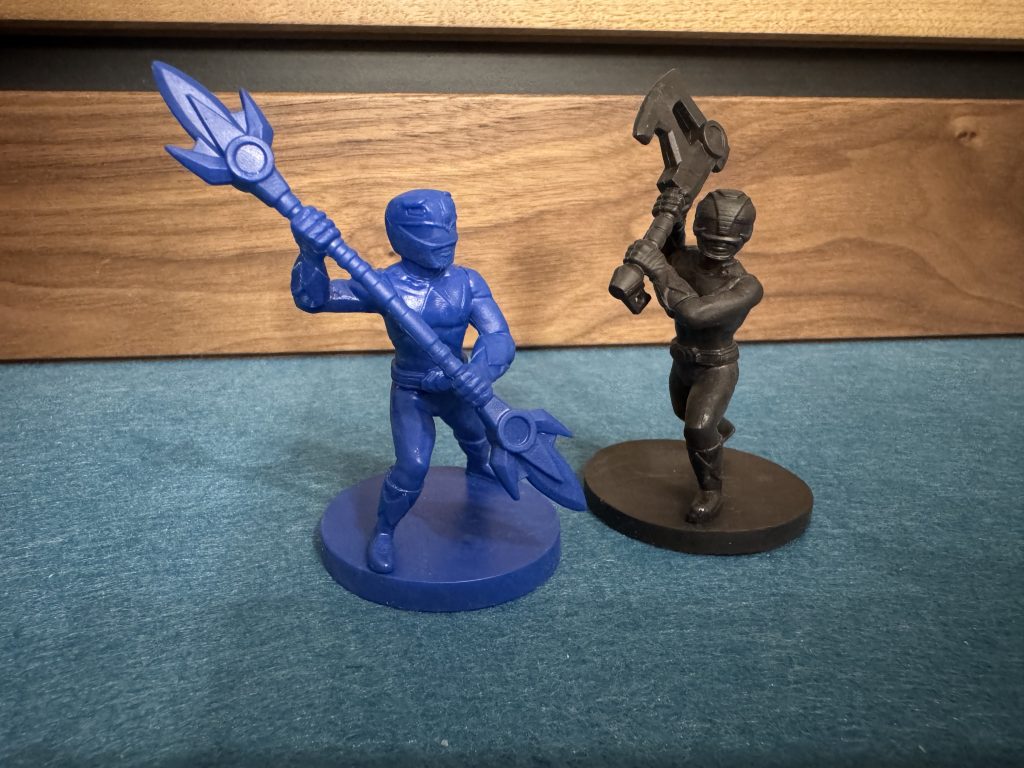
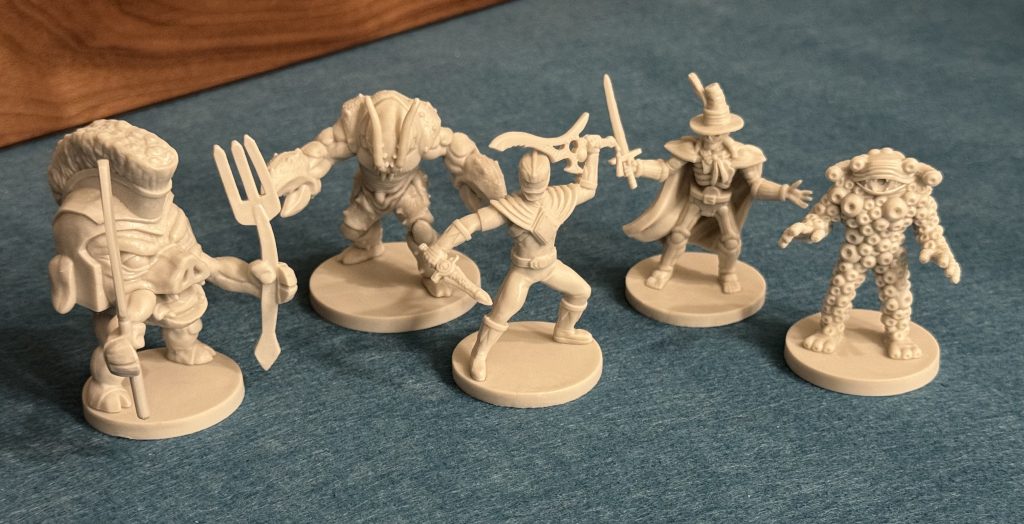
This game’s Kickstarter campaign ran in 2018, and my immediate pledge was driven by pure nostalgia. I love that the miniatures are large and colorful like the Rangers are known for, and the swarms of putty patrollers immerse you into the rising pressure to save the city from evil monsters like Knasty Knight and Eye Guy.
I received the core game and Kickstarter exclusive deluxe boxes in the original crowdfunding campaign and subsequently picked up many more expansions in subsequent crowdfunding campaigns. My collection also includes:
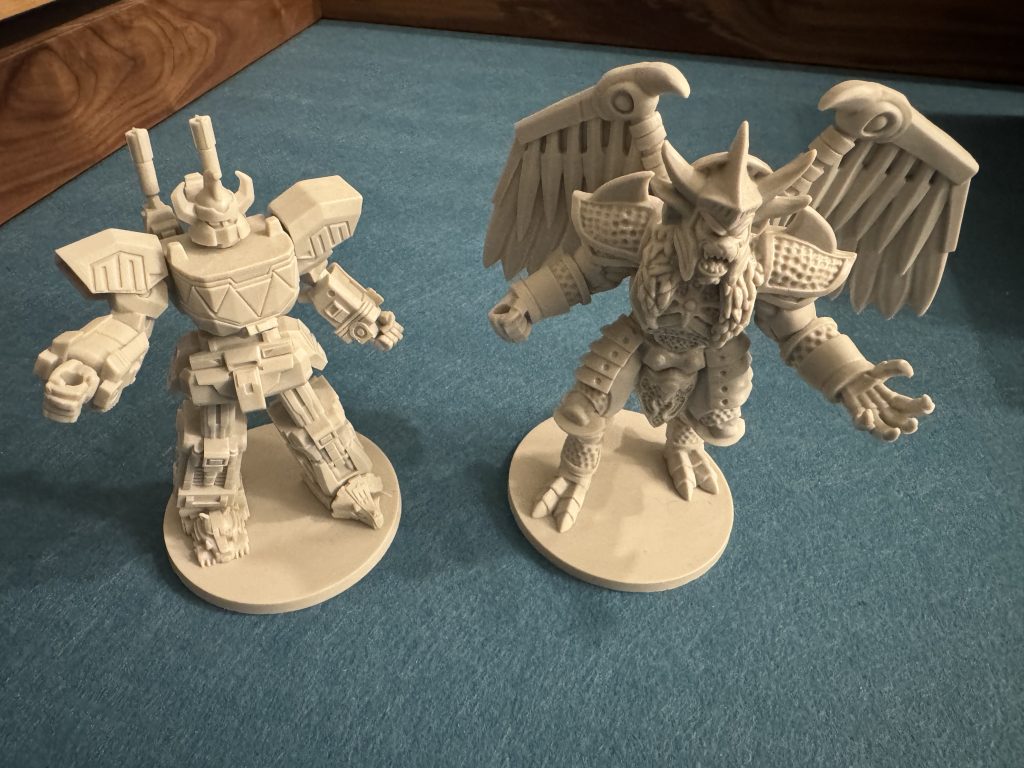
Megazord Deluxe Figure
Rise of the Psycho Rangers
Cyclopsis Deluxe Figure
Mega Goldar Deluxe Figure
Villain Pack #1
Villain Pack #2: Machine Empire
Villain Pack #3: Legacy of Evil
Zeo Ranger Pack
Zeo Gold Character Pack
Rangers Allies Pack #1
Legendary Rangers: Forever Rangers Pack
Legendary Ranger: Tommy Oliver Pack
Squatt & Baboo Character Pack
Fan Appreciation Kit
Ranger Dice Set
Gameplay
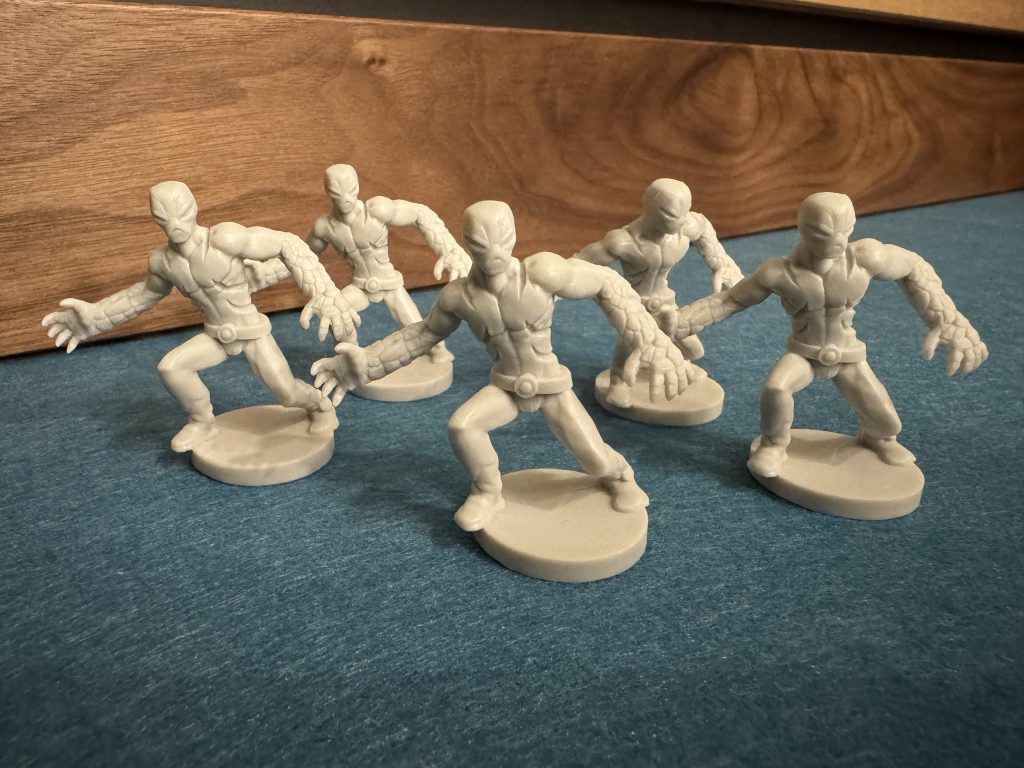
The structure of Heroes of the Grid is simple. Each round begins with a Deployment Phase, where you flip through a foot soldier deployment deck to populate the four outer locations which may include iconic locations such as Angel Grove High and Ernie’s Juice Bar. Foot soldiers are the most common enemy type but, eventually, monsters and the boss will show up to cause trouble. The deployment deck is constructed during setup in a specific order, with monster and boss deployment cards randomly seeded such that they will appear in later rounds. You know things are going to get worse. The question is how fast, and whether you’ll be ready.
Once enemies are deployed, the Rangers act freely during the Action Phase, with no defined turn order. Each Ranger has at least two action tokens (three or five in some player count configurations). Matching the simple round structures, Rangers have three available actions: Move, Battle, and Recover. Move allows a Ranger to go to any location on the board. Recover lets a Ranger pull cards back from their discard pile (up to six shields’ worth) and shuffle them into their deck. This is a crucial action because you use your deck to manage damage from enemies. And Battle is where the action lives.
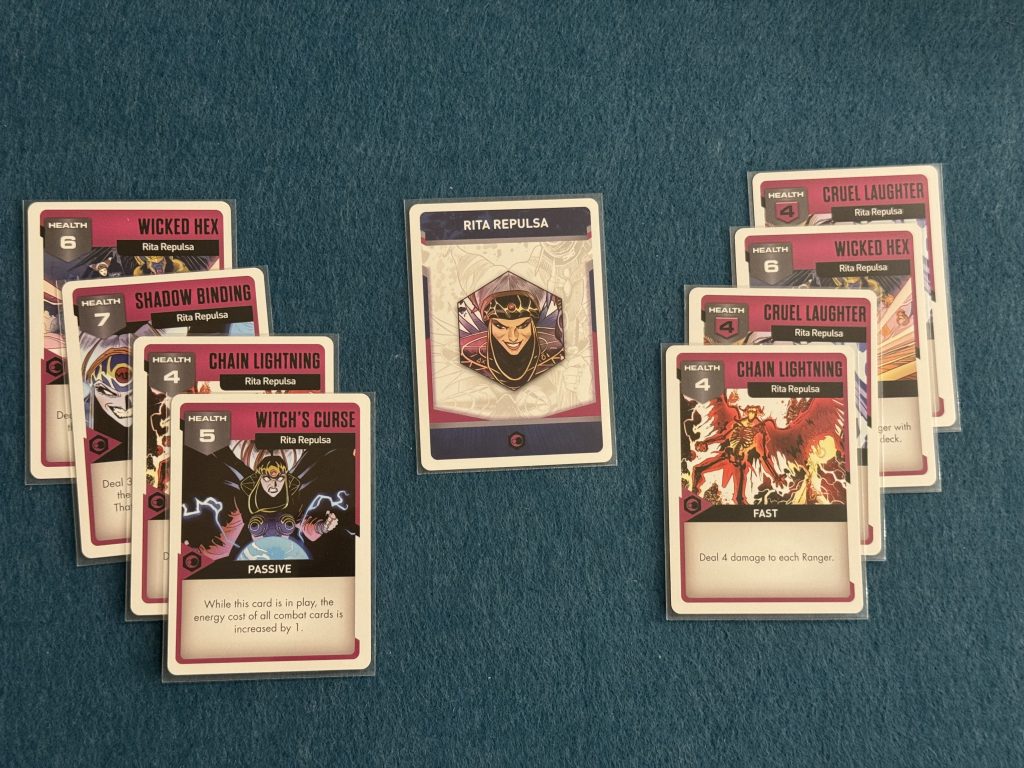
When a Ranger initiates a battle, every Ranger at that location participates. Two energy tokens are added to a shared resource pool, each Ranger draws up to their five-card hand limit, and the enemy cards are revealed. Foot soldiers in the location draw one card from their enemy deck, while the stronger monsters and bosses draw four cards from their unique decks. These cards are laid out in a specific combat sequence forming two rows of threats you need to work through as they resolve to cause trouble for the Rangers.
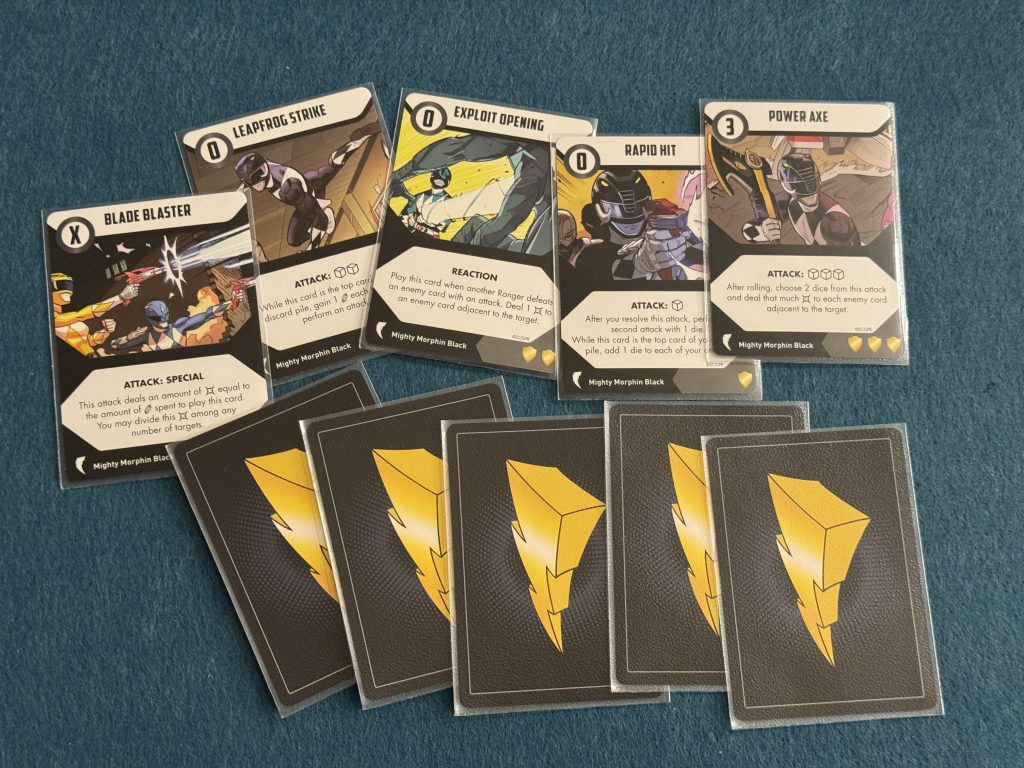
The battle sequence consists of Rangers and enemies alternating turns. On the Rangers’ turn, the team picks one Ranger to play a card from their hand, paying its energy cost from the shared and/or their personal resource pool. Attack cards target an enemy card in the sequence and deal hits, usually by rolling dice. Maneuver cards give you energy, manipulate your deck, or offer other useful effects. Reaction cards can be played at any time by any Ranger in response to what’s happening.
The combat sequence resolves from left to right on the enemy side and the order and arrangement of cards in the two rows matters. The enemies often use keywords, which are one of the game’s thematic design features. Fast cards force the enemies to act first, which can completely reshape the Rangers combat plan before anyone has played a single card. Guard cards protect cards horizontally and vertically adjacent from being targeted directly, limiting the Rangers potential attack targets. Passive cards give ongoing effects that can compound into serious pressure if not addressed and often thematically align with the enemy’s special abilities. Learning to read the combat sequence before committing your hand is where the game’s strategic depth lives.
Damage defense works through a revealing mechanic that I think is quietly clever. It is reminiscent of how wounds are applied in Mage Knight: The Board Game. Rangers don’t have hit points or a specific amount of health. Instead, when a Ranger takes damage, they flip the top card of their deck and check its shield value against the incoming damage. If the shields are greater than the damage, the card goes to the bottom of the deck. If not, it gets discarded. If there is any damage remaining, you flip the next card and continue the process. You’re burning resources to stay alive, which makes deck management feel genuinely consequential, especially with only ten cards in your Ranger deck. This often leads to turns where the Recover action isn’t just a nice idea, but a must for survival.
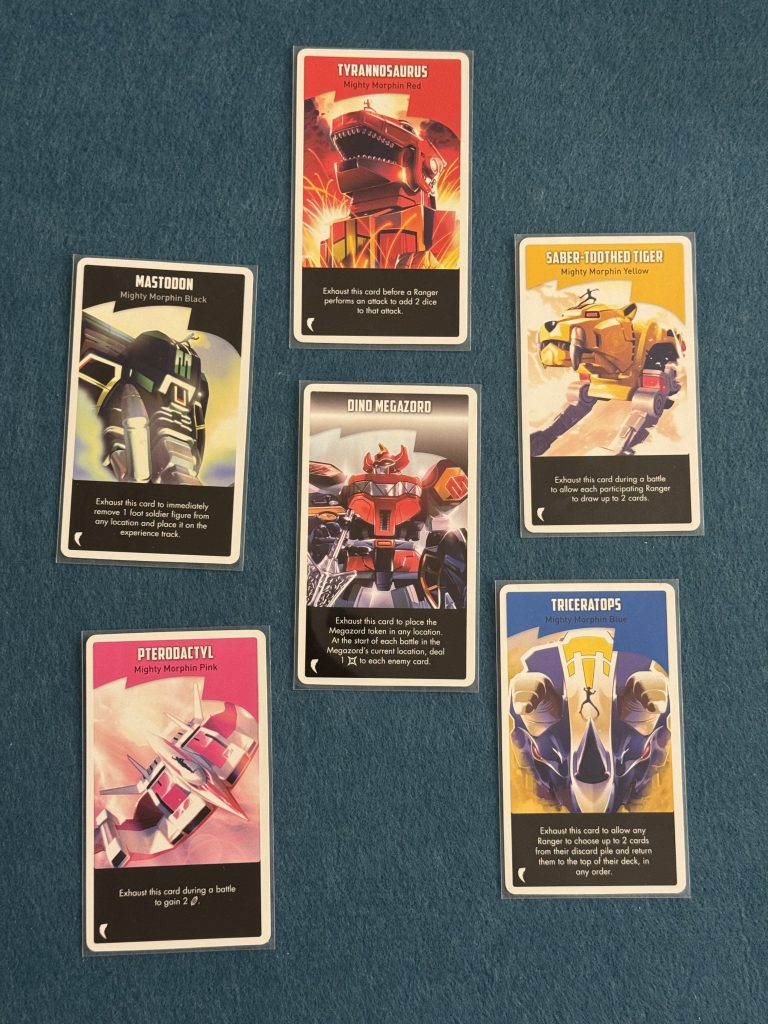
The Power Rangers iconic Megazord has also been incorporated into the game. Defeating foot soldiers earns the Rangers’ experience, and filling the experience track summons a Zord card, advancing the Power Marker and giving a Ranger a new ability. This progression also gets the Rangers one step closer to deploying the Megazord. Rangers also get a free level-up on the power track and receive a Zord card every time they defeat a Monster.
But the challenge only grows as tougher enemies arrive on the board. Monsters require defeating four of their enemy cards across one or more battles. And the boss (Rita Repulsa in the core game with multiple options to choose from in expansions) requires defeating six enemy cards. You’re not going to end this game in one big fight. You’re going to fight the boss multiple times, chip away at their card pool, and hope the rest of Angel Grove holds together long enough to finish the job. When you’ve defeated the boss, the Rangers have won the game!
Field Testing and Replayability
I’ve played this game with one to five players and I enjoyed every player count. Each Player count does change the feel of the game and the urgency to clear locations of enemies before it becomes panicked. At five players, it feels very thematic, like a full team that can create a lot of discussion during combat, particularly when energy is scarce and every card choice matters. Higher player counts also have more flexibility to divide into smaller teams to battle enemies. However, at one and two players, you’re controlling multiple Rangers simultaneously with a hybrid combat deck, which I’ve found can be more complex but also gives you a greater number of choices on your turn.
Every Ranger plays genuinely differently. In the core box, Jason Lee Scott, Mighty Morphin Red, has the Power Sword combat card which is a huge five-dice attack that adds dice to the next Ranger’s attack after resolving his own that combines well with his ranger ability to allow dice rerolls. It rewards sequencing and teamwork. Billy Cranston, Mighty Morphin Blue, has multiple combat cards that trigger special effects when revealed for defense making him adept at blocking damage. Kimberly Ann Hart has the Quick Shot ability that deals one hit to an enemy of her choice at the start of each battle and her Arrow Shot card bypasses the GUARD keyword, making her a strong choice against guarded enemy card sequences. Trini Kwan’s Double Strike ability lets her play two copies of the same card in a single turn once per battle, which enables burst turns before the enemies get another swing. Zack Taylor’s Hip-Hop Kido ability and multiple of his combat cards allows him to splash damage to adjacent enemies, which chains beautifully against clustered enemy cards.
Not only is combining these abilities in a battle fun, but designing your team is exciting. For fans of the franchise, there is something both uncanny and exciting about mixing Rangers from different seasons of the show or playing with different iterations of the same Ranger. The variety of combinations means this game can be replayed as a unique experience each time and keeps me excited to play through different expansions and add-on content.
While there is plenty of variability in the team composition, deployment deck, enemies, and dice rolls, I feel that there are common themes you learn as you play more and more games. There is a rhythm to the enemy deployments and pacing you develop in order to get your Zord cards out before the boss arrives. I like to think of the power track as more than a progress meter. It’s telling you how ready you are for the monsters and boss. Because locations have figure limits leading to the panicked condition (one of the loss conditions), you are forced to clear out some foot soldiers and monsters first, building up your bank of Zord abilities, all while preparing yourself for the final boss.
Additionally, you can ramp up the difficulty by facing tougher bosses like Cyclopsis or Mega Goldar that add new twists to the enemy card sequence. You can even add additional monster and boss cards to the deployment deck or check out the special bonus scenarios designed to give you pre-constructed setups with special rules. And if you need to tone down the challenge level, you can cut back on the number of enemies deployed each round or give the changes more energy.
Notable Discovery: The Deployment Deck
The deployment deck is the game’s simple, yet effective design gem. It can also be a stress inducing menace. First, structured into four piles of foot soldiers, monsters shuffled randomly into the middle two piles and the boss into the last. This means every game has an escalation arc built in from the moment you sit down. You know the boss was shuffled in pile D, you can’t stop it from coming. Additionally, you don’t know when exactly the boss will show up or which location board it will land on.
The moment a monster deployment card appears is when the tension spikes. When Pudgy Pig or Madame Woe lands on the board, that location instantly panics. Now you have a ticking clock: fight through that location’s foot soldiers, then face the monster across as many battles as it takes to knock out four of its cards, without losing the rest of Angel Grove to panic in the meantime. The board pressure and the battle pressure operate on two different clocks, and managing both simultaneously is the game’s best aspect.
Notable Discovery: The Zord Cards
The Zord system is lean, but effective. The designer cleverly incorporated the iconic robots of the series as powerups into a game largely based on the rangers fighting at the ground-level instead of alongside giant monsters and skyscrapers.
There are five regular Zord cards, one per your standard team of five Rangers, plus the Megazord card at the bottom of the deck. You summon them regularly by filling the experience track with defeated foot soldiers or by defeating a monster. Each summoned Zord gives the associated Ranger a powerful, new ability they can exhaust once per round. The Saber-Toothed Tiger lets each participating Ranger draw up to two cards in combat. The Mastodon can remove a foot soldier and add it to the experience track. The Dragonzord can spread excess damage to another enemy card.
What makes the Zord system work is the buildup. Just like the deployments are working on a clock, the Zords are arriving on a similar yet different timing system. By the time the Megazord arrives, you’re playing a meaningfully different game than you were in round one as you’ve defeated plenty of enemies and are likely ready to take down the boss. And the Megazord’s ability provides the kind of dramatic swing that can motivate a team of Rangers by dealing damage to every enemy card.
Observer’s Notes
Power Rangers: Heroes of the Grid was the game I cited in my Grimcoven review when I talked about dice randomness done the wrong way. I want to be fair to it here, because the comparison wasn’t a dismissal. The praise throughout my review is real and so is this frustration. Attack combat cards often specify a number of dice to roll, and the hits you deal are whatever the dice produce. Some turns you roll five dice and get two hits. Some turns you roll three dice and get five hits. The variance is wide enough that occasionally a well-constructed turn just fails, and the enemy sequence marches forward with guaranteed damage while your hand and deck empties.
Grimcoven and Dragon Eclipse both solve this problem in different ways: fixed damage values tied to specific die symbols, or no offensive randomness at all. Heroes of the Grid sits in an older board game design tradition where dice rolls determine damage. It’s not a dealbreaker, and the combat sequence’s transparency helps you pre-plan around potential bad rolls. But it is something to consider, especially with players who get frustrated by randomness.
Field Report Summary
Current Status: Useful Gear (Want to Play Again)
Rules Accessibility: One of the most approachable cooperative games I own. The round structure is two phases, combat is four steps, and the back of the rulebook contains all the icons and keywords you need to know. A new player can be up to speed after their first combat.
Replay Potential: Each Rangers play differently enough to warrant revisiting the game with different team compositions. The deployment deck’s randomized monster placement ensures no two games unfold quite the same way. And the plethora of expansion content adds additional Power Rangers, new monsters and bosses, and new Zord cards to satisfy any craving for more content.
Components: Dan Mora’s art stands out and evokes the fun superhero theme that is the Power Rangers franchise. The card quality is solid and the miniatures provide a nice table presence. The location boards are easy to navigate and overall provide an efficient use of table space.
Time Investment: Sixty minutes is accurate for an experienced group. Early game sessions might run longer as you learn the flow. Setup and teardown are both quick, but with all the expansions, you can lose time simply choosing your preferred combination of components.
Portability: While it can be challenging to travel with everything, you can easily fit everything you need for a game in the medium-sized core box with room to spare. Simply pick and choose a few expansions to bring with you when traveling for game night.
Recommended Team Size: Two to three players is my favorite, but all player counts work well.
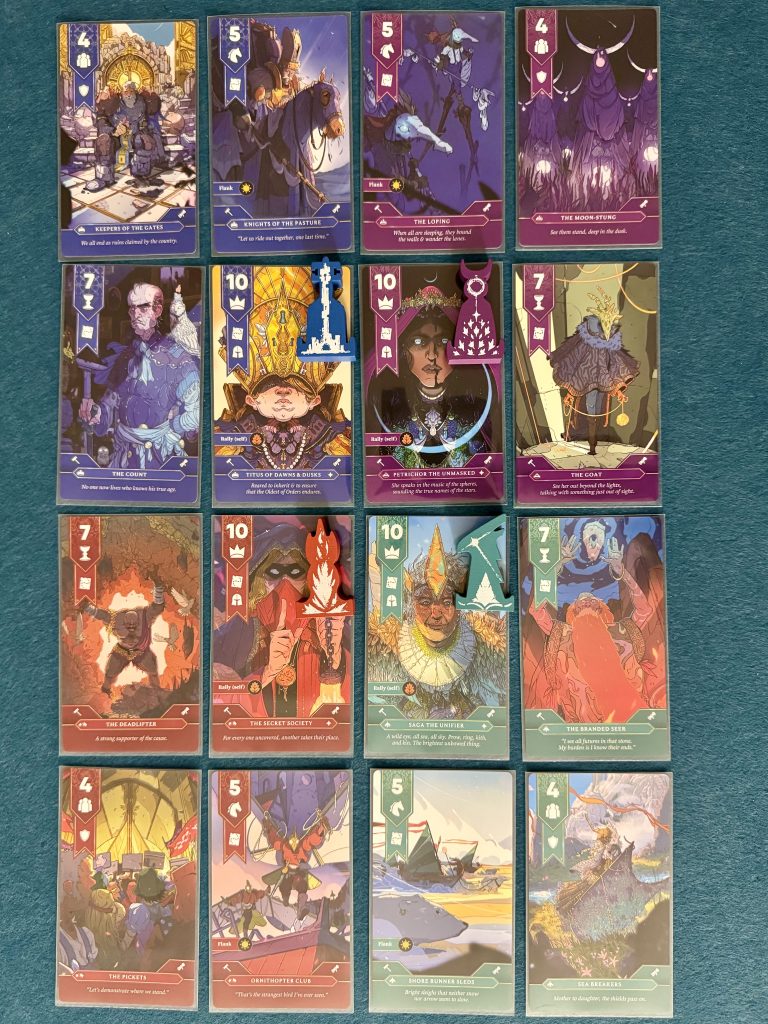
In this asymmetric betting and bluffing game, two to four players take on the roles of heirs to a fractured kingdom, each commanding a unique faction vying for influence. You win by accumulating the most Influence tokens across a series of rounds, each representing a year of political and military struggle. The core mechanism is blind bidding, simultaneously playing face down cards to contest regions of the map, bidding on powerful Kingdom Cards, and bluffing your opponents into costly mistakes. Simple stakes with a surprisingly deep decision space.
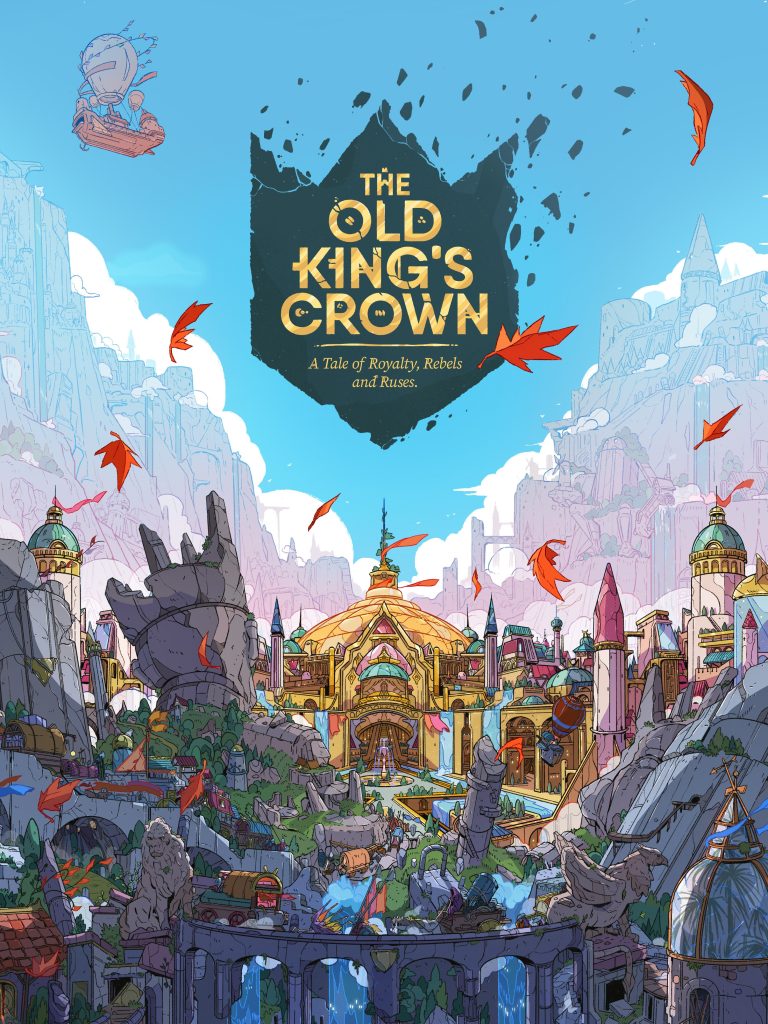
I’ve really enjoyed The Old King’s Crown. Pablo Clark’s painterly illustrations on large tarot-sized cards pulled me in before I even knew the rules, and the game more than delivered on that first impression. The seasonal structure gives each round a satisfying rhythm, and the face down card system generates the kind of tension that makes you replay every decision in your head afterward. My one concern is the potential for random outcomes to frustrate players who take losses personally, something to keep in mind when choosing your game group.
Current Status: Useful Gear (Want To Play Again)
Overall, it’s a strong addition to my collection and I’d recommend it to fans of blind bidding, asymmetric strategy, and games that reward reading your opponents. If you’re comfortable with calculated risk and you enjoy the cat-and-mouse of predicting what someone else will do, there’s a deeply satisfying game here.
⬇️ Keep reading for my full thoughts ⬇️
Initial Observations
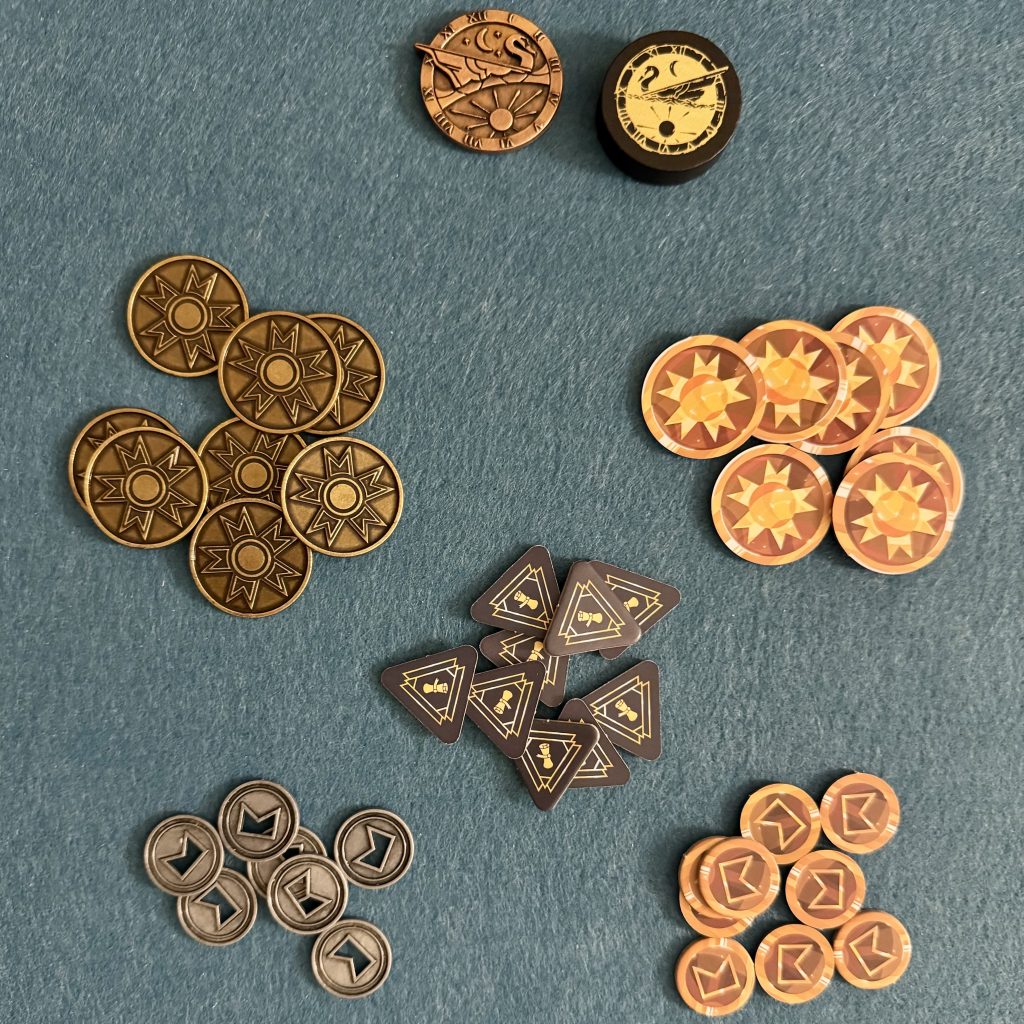
Pablo Clark’s painterly and atmospheric illustrations on large tarot-sized cards were what drove me to learn more about The Old King’s Crown. I was hesitant about betting and bluffing with face down cards, but the clean design and easy to understand battle mechanics kept me interested. I also enjoyed watching Pablo Clark’s livestreams as he drew new art for the game. I backed The Old King’s Crown on Kickstarter in November 2023 and received the base game and the Wild Kingdom expansion. As a Kickstarter backer, I also received a metal active player token.
Gameplay
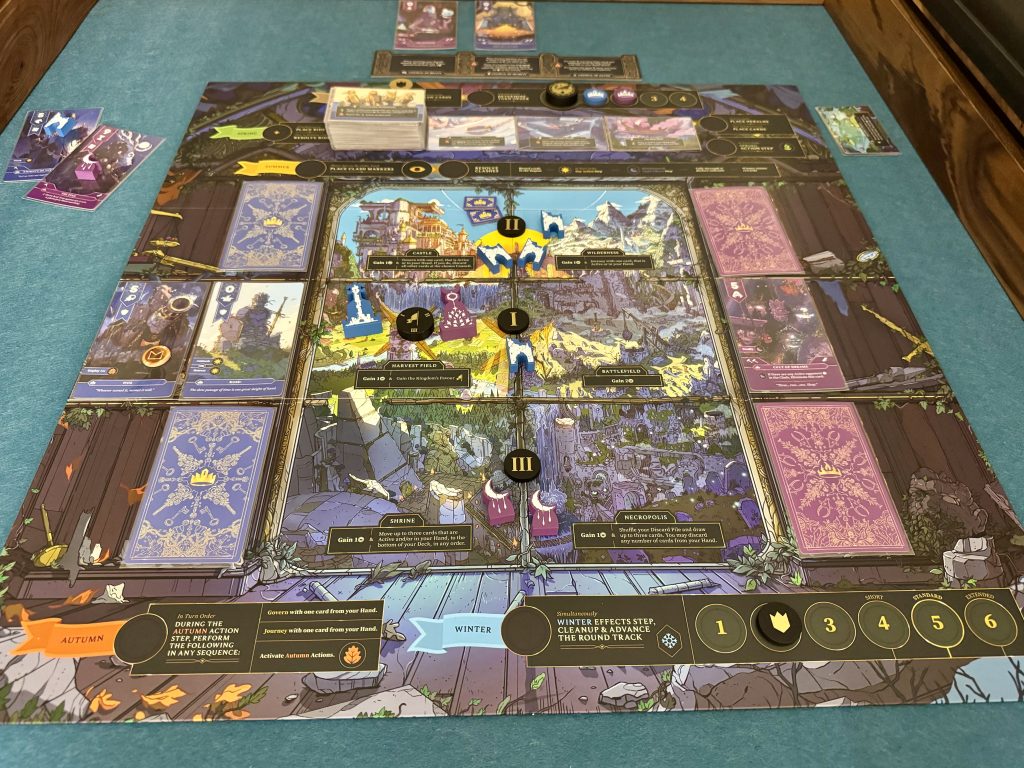
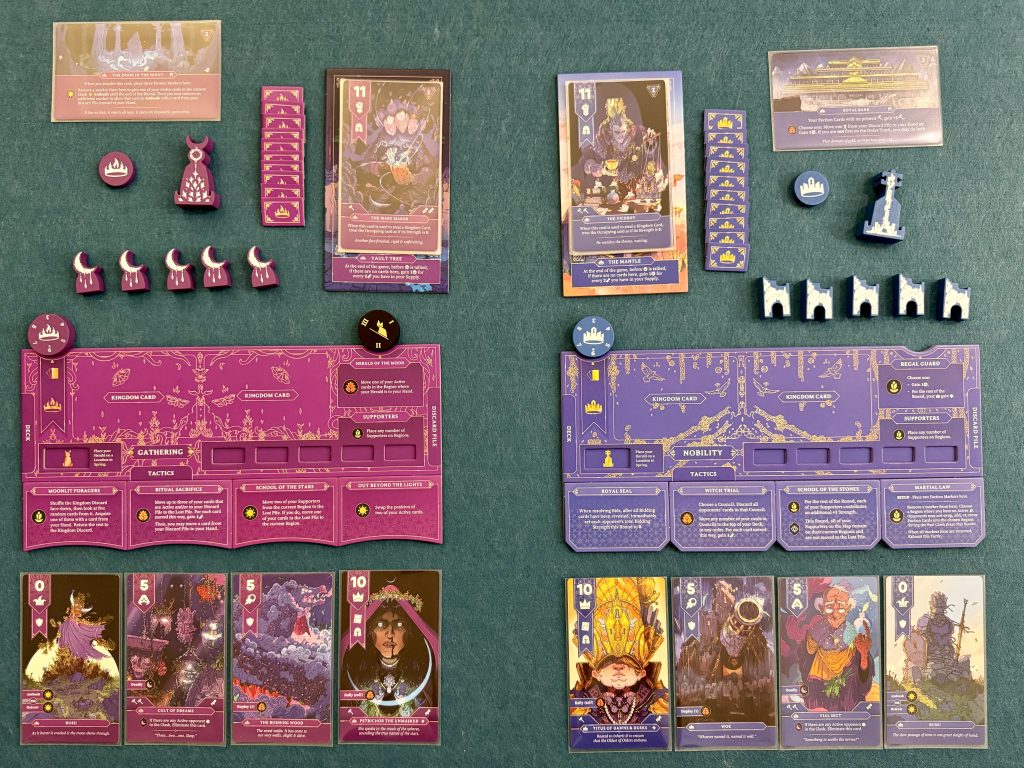
At first glance, the massive Kingdom Board feels daunting despite its beautiful art. The board doubles as a window into the kingdom and your guide through the game structure, walking you through each season of every round. You take on the role of an heir to the kingdom with a faction by your side (the Nobility, the Clans, the Uprising, or the Gathering). Each faction shares similar card types but comes with unique Tactic abilities and unlockable Advanced Faction Cards that make each feel genuinely distinct from the start.
Thematically, each round represents a year of conflict, and that framing carries through the mechanics. Seasonal abilities only activate in the phase they’re tied to (Spring, Summer, Autumn or Winter) which makes the annual concept feel meaningful rather than decorative.
The heart of the game is simultaneously playing cards face down. You use this mechanic to bid on Kingdom Cards, a deck of unique abilities and benefits acquired either by winning bids or stealing from other players. You also place three Faction Cards face down beside each region (the Highlands, the Plateau, and the Lowlands). Adding to the tension, the player last on the order track decides the sequence in which each regional clash resolves. Each Faction Card has a strength value, commands, and traits that determine how it behaves in battle, and some abilities trigger in player order while others resolve simultaneously. Predicting what your opponent will play while also choosing the ideal flip sequence for your own cards creates a wonderfully layered decision space.
There’s a second layer of bluffing even before cards are placed. Placing your Herald, a bonus-granting piece that can also steal points, telegraphs information about your intentions. Did you put your Herald on the Necropolis to recover your key cards from your discard pile? Or to lull your opponent into thinking that’s where you’ll concentrate your strongest Faction Cards? The strategic space around the Herald is rich, before the face down cards even enter the picture.
Once Summer ends and the clashes resolve, Autumn opens up a fun new game space. Players can Govern with Faction cards to activate special abilities in the various Councils. A thematic political twist useful for gaining extra Influence or recovering lost Supporters. The Journey mechanic introduces Lore, the game’s true currency. While Influence tokens may look like coins, Lore is what lets you buy your unique Advanced Faction Cards. These come with higher strength values, stronger abilities, and some arrive as HQ cards, tarot-sized cards turned sideways that grant persistent abilities. Winter, finally, is cleanup time. You reset the board, potentially lose Supporters, and see whose Faction Cards survive into the next year.
No matter how many clashes you win or how well you manage your hand, what ultimately decides the game are Influence tokens. That clear throughline keeps every decision focused.
Field Testing and Replayability
I’ve played all four factions at least once, and each felt like a meaningfully different experience. Sometimes I leaned into deploying units, ambushing opponents, maintaining a board presence with Supporters, or controlling the Councils. I don’t have a clear favorite strategy, and that’s exactly what keeps drawing me back in. Learning when to use each faction’s Tactics has been one of the game’s best puzzles. Activate them too early and your opponents may outlast you in later rounds. Wait too long and the game may end before you get the chance.
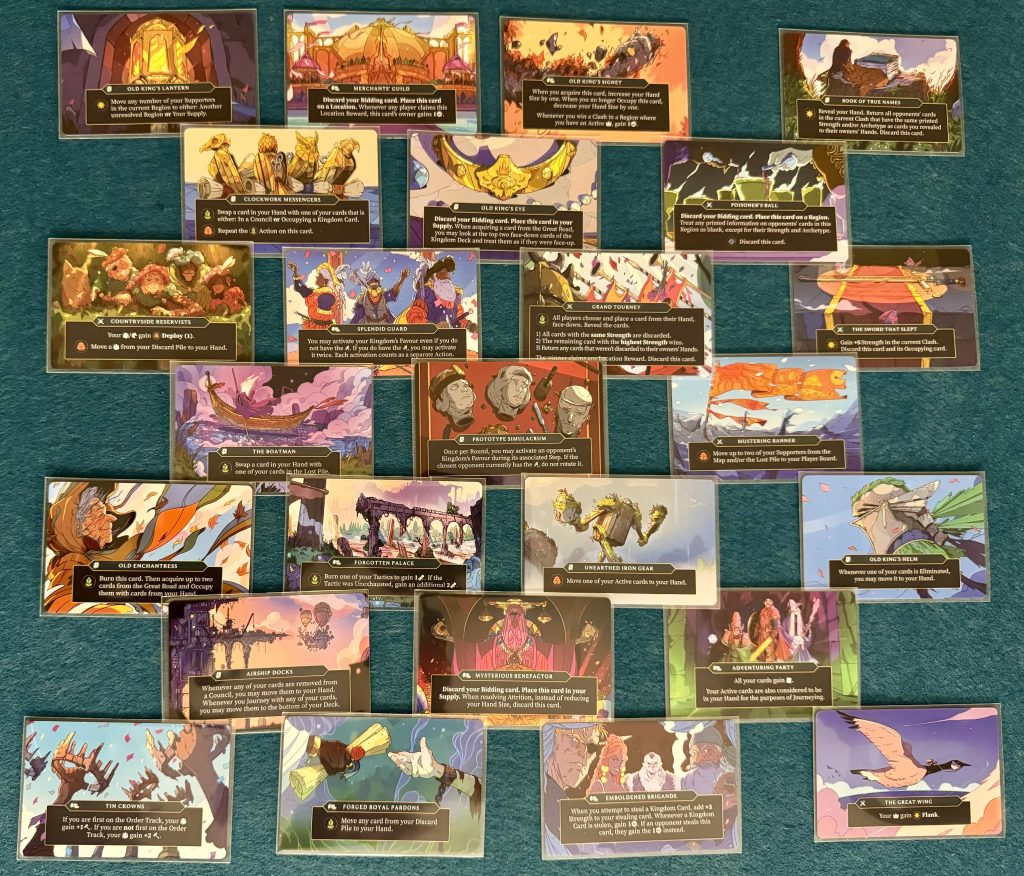
The Kingdom Cards add another layer of variability. More than once, I started with a clear plan and then changed it entirely when a new card appeared on the Great Road. A friend built a combo with two Kingdom Cards that created overwhelming chain reactions in clashes that I hadn’t anticipated. A satisfying example of how these cards can reshape the game.
One word of warning to players who lean toward cooperative games, as I do. There is a cooperative mode that pits players against the Simulacrum, but this is fundamentally a competitive game. And it’s a competitive game where you can be as ruthless as you want. There are graceful ways to win and brutal ways to dismantle your opponent region by region. Because cards are played face down, a player’s loss can occasionally come down to chance. I enjoy that element, but I’m cautious about playing with anyone who takes outcomes very seriously. The randomness inherent to predicting your opponent’s moves is part of the experience, not a flaw. But this game needs to land at the right table of players and that will limit when I play this game.
The Old King’s Crown is, at its core, a game of blind bidding. A clean, well-executed mechanism wrapped in a beautiful world with asymmetric abilities and rule-changing Kingdom Cards that keep each session feeling fresh. I’ve had close matches, including one that required a tiebreaker check. Even when a round swings in someone’s favor, the war hasn’t been decided until the very end. Managing your hand, your Supporters, and your abilities is a rewarding balance across every round.
You can also adjust the game length to fit your needs or raise the stakes and scores. You simply choose four, five, or six rounds (a short, standard, or extended game).
Notable Discovery: Kingdom Cards
The Great Road is the game’s auction house, where you can acquire unique powers by spending a card from your hand. The Kingdom Cards are where you’ll find the full variety of Pablo Clark’s art and world-building, and it’s where some of the most game-altering abilities live. There were consistently more appealing options on the Great Road than I had room for on my player board. The limit of two Kingdom Cards at a time is a satisfying constraint. Watching a well crafted combo unfold mid-game is one of the most memorable moments.
Notable Discovery: Simulacrum
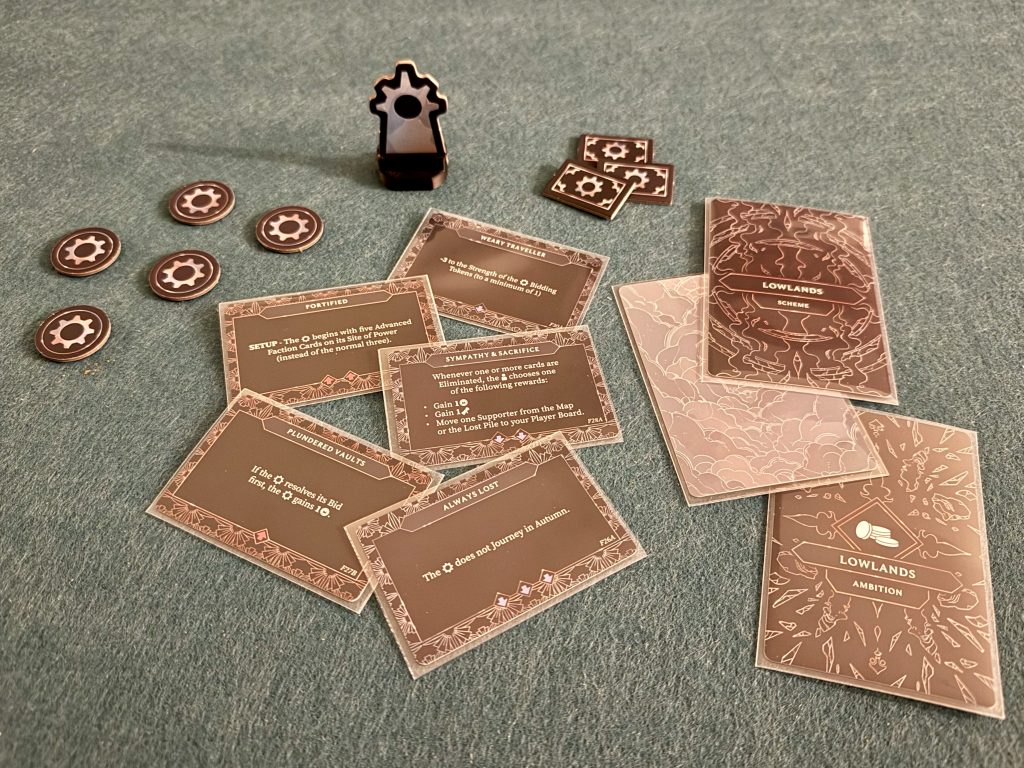
The solo mode is impressive for a game built around hidden information. Rather than defaulting to random behavior, the Simulacrum uses Threat, Fog, Ambition, and Scheme cards to emulate human tendencies, giving you a read on what it might do in each region while still forcing genuine decisions. A solo game against the Simulacrum, while challenging, feels complete rather than a workaround.
Observer’s Notes
Props to the Eerie Idol team for creating both an Introductory Strategy guide and a Teaching guide (link). The rules themselves are approachable, but developing a real strategy takes time, and these guides do a lot of work in orienting new players toward meaningful decisions.
My practical note is that I wish the game shipped with multiple copies of the physical player aids. Having only one means players share it, occasionally causing small friction in game sessions.
Field Report Summary
Current Status: Useful Gear (Want to Play Again)
Rules Accessibility: The gameboard acts as your guide through each season of every round, and the included player aid covers the symbols and abilities found on Faction Cards well. The barrier is less about rules comprehension and more about building strategies.
Replay Potential: Each Faction plays differently enough to warrant multiple game sessions, and the large Kingdom Card deck introduces consistent variability. Different opponents change the character of every clash. Expansions add further layers when the base game’s variety wears thin.
Components: The cardboard tokens are well-illustrated and the metal tokens have satisfying heft. Artwork across the board is vibrant and the materials are durable, holding up well to repeated play.
Time Investment: Setup and clean up are quick. Total game length depends heavily on player decision speed, particularly during clash setup and resolution. The most variable and engaging stretch of each round.
Portability: You’ll need a large table for the boards, but everything fits neatly in the medium-sized game box.
Recommended Player Count: Two to three players is the sweet spot. At two, every clash is a tense head-to-head battle with no margin for error. At three, chaos and unpredictability enter the picture, which adds to the fun while keeping all players watching each other closely.
Art Direction: Patryk Jędraszek and Adrian Radziun
Publisher: Awaken Realms
Player Count: 1-5
Estimated Play Time: 120-240 minutes
Box Size: 15in x 13in x 7in
Quick Debrief
In this cooperative boss battler, two to five Hunters take on a single massive enemy called a Griefbound, alongside its minions and an elite enemy. Hunters lose if time runs out or anyone dies. To win, kill the Griefbound before it kills you. Pick your scenario, build your team, and get straight to the fight.
I’ve really enjoyed playing Grimcoven. The sundrop miniatures and gothic atmosphere are immediately striking. The game earns its massive table presence, but the scale between the Hunters and the towering Griefbounds puts you inside the fight. The dice placement system is the mechanical heart, and it rewards planning over luck. Each session feels different enough that I finish one already planning the next.
The setup and organization ask a lot of you, especially if you own all the content. The walkthrough scenario is also a poor first impression. Don’t judge the game by it!
Current Status: Essential Equipment (Must Own)
Overall, it’s essential in my collection and I’d recommend it to any fan of boss battlers, cooperative strategy games, or miniature-heavy productions that deliver on atmosphere. If you don’t mind the table space requirement and setup time investment, there’s a deeply satisfying game waiting on the other side.
Initial Observations
I had been following Awaken Realms’ Gamefound projects for a while after playing Dragon Eclipse and Castles of Burgundy: Special Edition. Dark, Victorian horror isn’t usually my genre, but the combination of grim hunters and large, threatening enemies pulled me in. This game has an immediate sense of spectacle and the miniatures only add to the drama. I backed Grimcoven on Gamefound in June 2024 and received the Special Edition core box with sundrop miniatures. I was happy with my previous all-in pledges so I opted for extra content:
Personal Stories
Hunters expansion
Forgotten Entities expansion
Renegade Hunter mini-expansion
Terrain miniatures
Companion miniatures
Acrylic tokens
Neoprene play mats
Gameplay
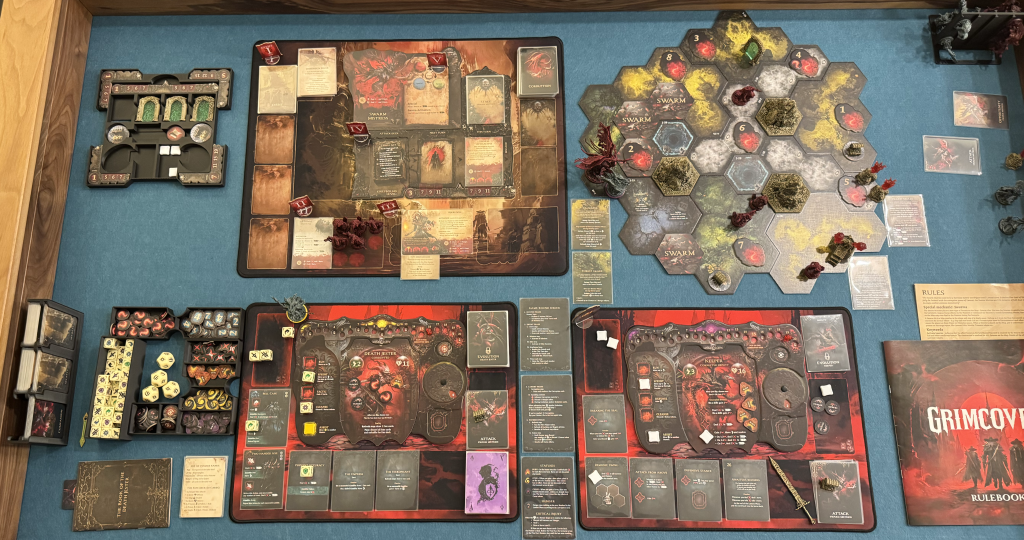
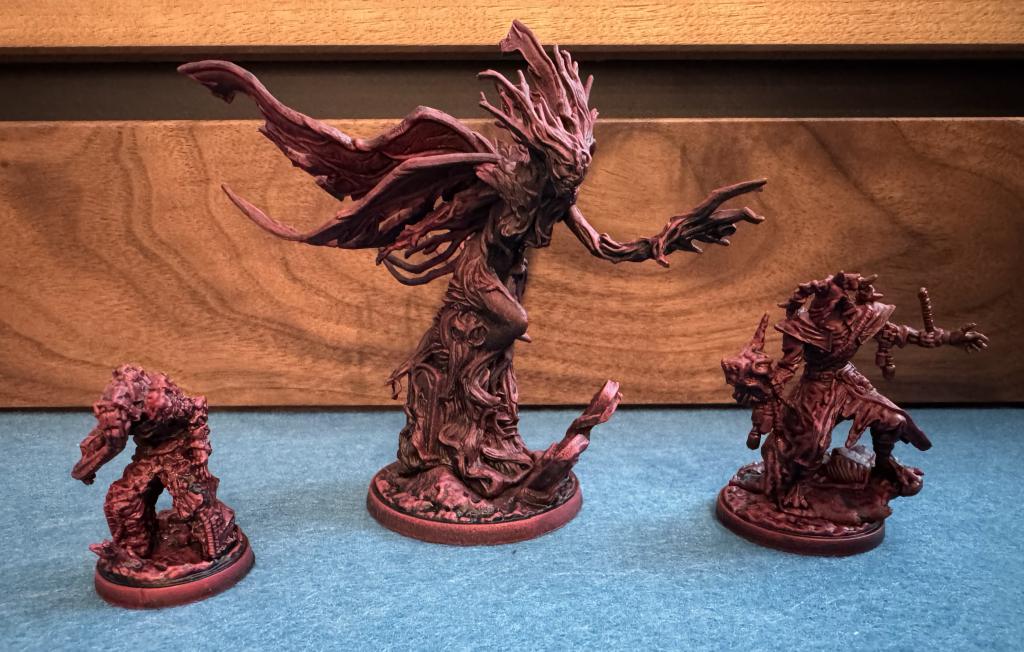
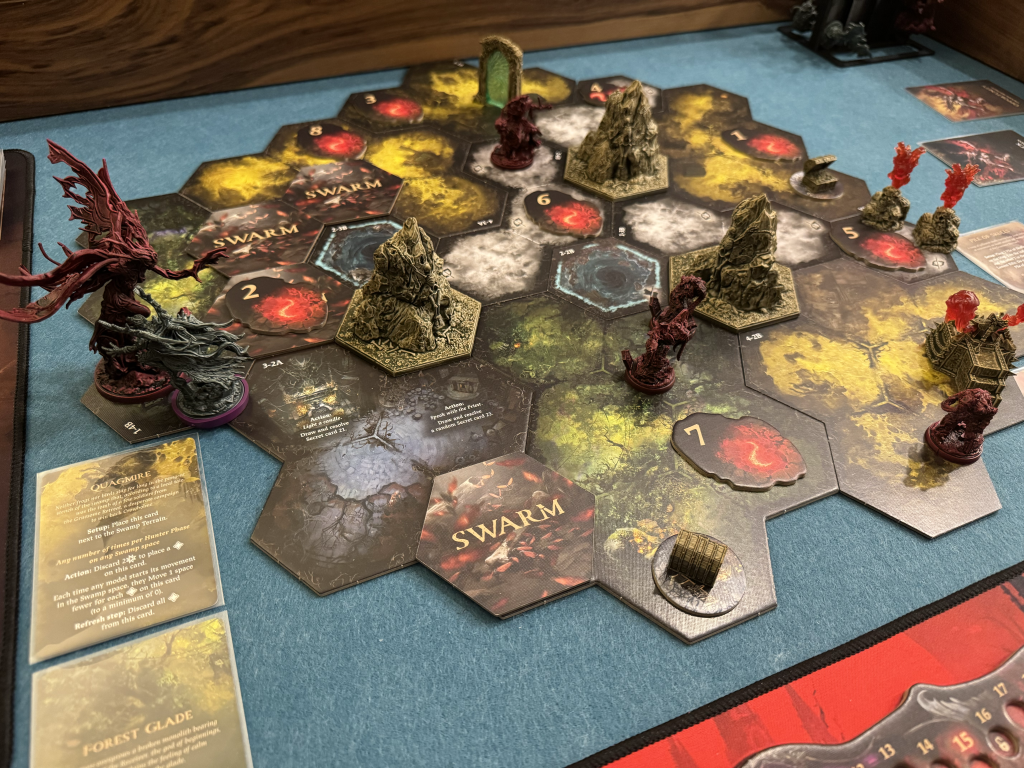
At first sight, Grimcoven is a daunting board game with a large table presence. The giant boss miniatures called Griefbounds genuinely feel threatening, look grotesque, and pull you into the atmosphere. Fortunately, the game helps walk you through its complexity with components like easy-to-read standees guiding you step by step through the enemy phase, so the physical layout becomes your teacher. In this boss battler, two to five Hunters fight one of the many Griefbounds with a variety of elite enemies and minions. If time runs out or one Hunter dies, the players lose. To win, you must kill the Griefbound. Simple stakes, but the road to get there is anything but.
The players are Hunters in this universe who swore an oath to resist the temptation of Lament, a dangerous, corruptive power, while risking their lives to defeat terrifying entities. From the start, this game gives you an impressive number of ways to customize your experience. Each Griefbound comes with five scenarios of increasing difficulty that change the map, cards, and minions, and randomized elements to ensure the same rarely plays the same way twice. Specific terrain and location cards tied to the map offer optional actions that add to the story through secret cards, introduce new obstacles, and can even save you from defeat at a critical moment.
When choosing your Hunter, you also pick their starting weapon and armor, which directly shapes your dice pool. In this game, dice are your action economy. Once rolled, you match symbols on the dice to symbols on your cards and player board. This strategic placement puzzle is where the game shines. It never feels punishing because you’re generally using dice that weigh your odds toward specific symbols you need, and specific abilities allow you to reroll or share dice symbols with other Hunters.
Turns stay quick and snappy despite the game’s complexity. Each Hunter is limited to two actions per turn before passing clockwise, which keeps the game moving, forces teamwork, and prevents downtime that plagues heavier games. The Hunter phase can still run long as players choose who to attack, where to move to stay safe from the Griefbound’s next strike, and how to split resources like treasure chests and Lament. But when the Enemy Phase begins, it runs on rails.
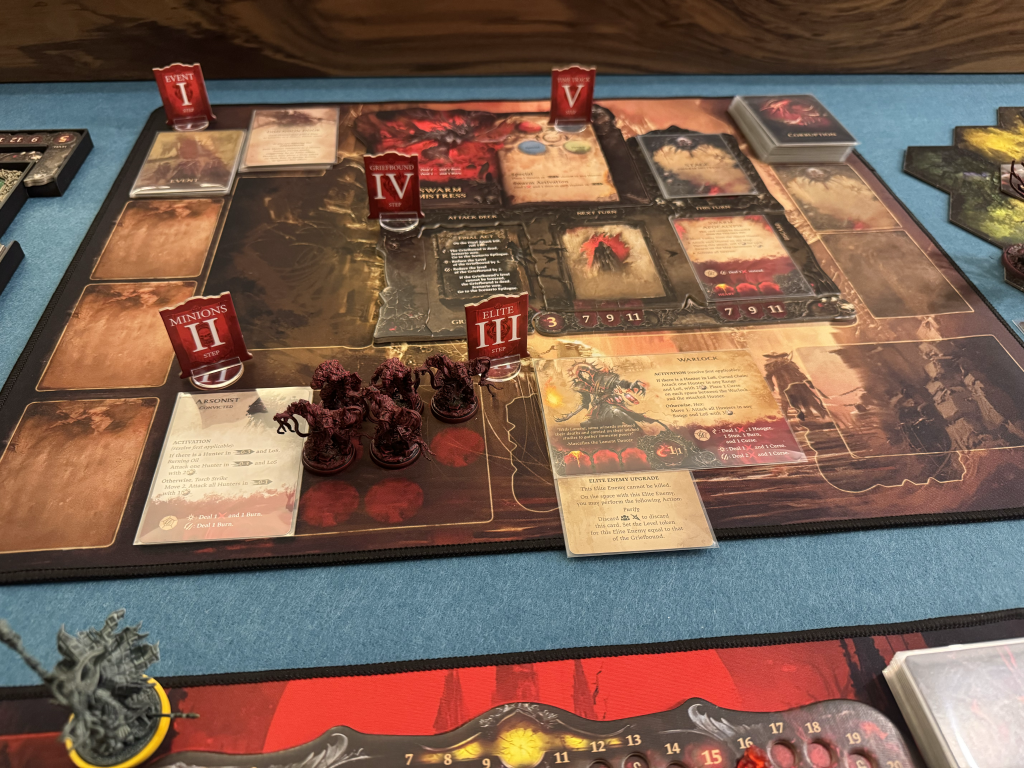
Players must survive a random event card, the activation of up to eight minions, the activation of a powerful Elite enemy that has the maddening ability to return after death, and the Griefbound itself. Crucially, all enemy actions are telegraphed through face up cards, and Griefbound’s next two attacks remain a known quantity. That transparency enables the kind of fun, tactical planning the Hunters phase is built for.
There’s still randomness to wreck a well-laid plan. Each Hunter must draw a corruption card every round, and Lament, while powerful, raises your corruption level and makes those cards nastier. Feeling hungry? It’s quite possible that you’ll turn on your fellow Hunters mid-battle.
In games like Power Ranges: Heroes of the Grid, dice determine damage output. I still remember rolling eight dice in Power Rangers Heroes and doing zero damage to the enemy. There is nothing more frustrating than randomness dismantling your carefully built turn. Grimcoven, like Scott Pilgrim Miniatures the World, uses dice differently. They determine which actions you perform, and those actions have fixed damage values. Removing damage output randomness from the player side is a smart design call, and it makes growing your dice pool genuinely exciting. More dice means more options and a richer decision space, not just bigger damage. The game designer was equally clever on the enemy side, tying their damage directly to enemy dice rolls so the opposition stays unpredictable.
Field Testing and Replayability
One warning before you sit down to play for the first time: don’t let the walkthrough color your opinions of the real game. The walkthrough does a poor job of marketing the fun by throwing you into an uphill situation. I played the playthrough and lost almost immediately. It wasn’t until a proper scenario that I understood what makes the game click.
I expected to feel overwhelmed and reluctant to dig into all the playable content. Playing both solo and as a two player experience changed that. The game is more balanced and accessible than it appears from the outside. The solo mode Deputy mechanic is a good enough solution that a solo game feels as good as two players. I don’t see myself playing at the maximum of five players, but a three player game that will fill my tabletop, or a two player run, both feel right. With each game, you get faster at game setup and more capable against each Griefbound’s attack card. Learning each Hunter’s strengths and weaknesses has been half the fun.
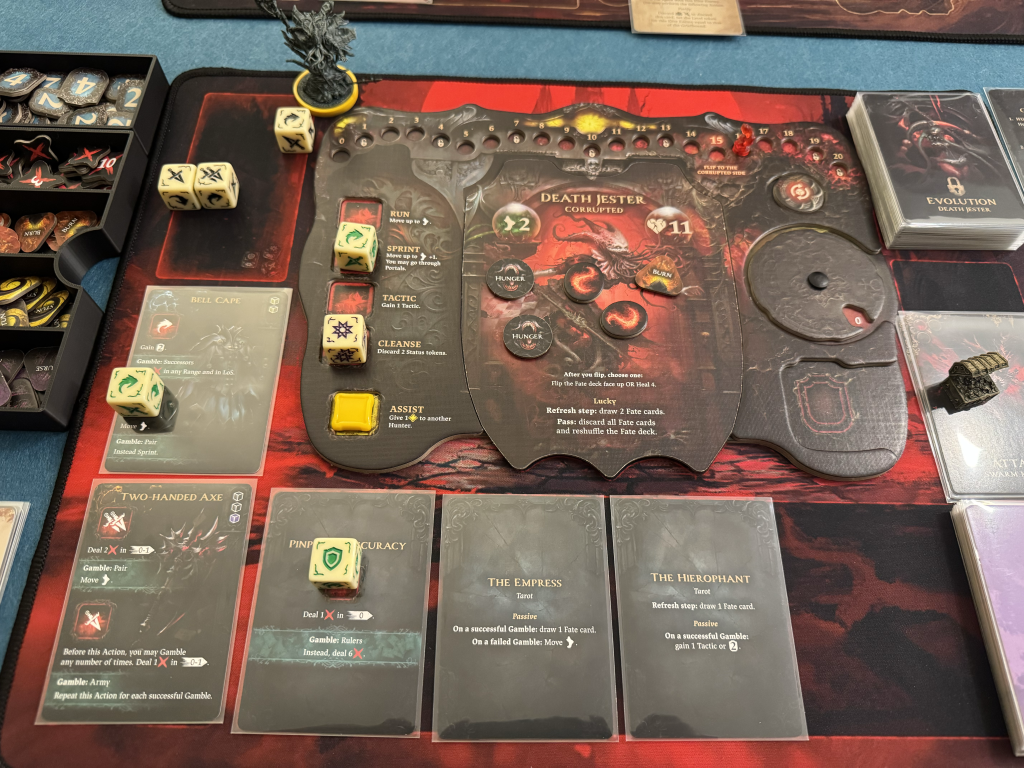
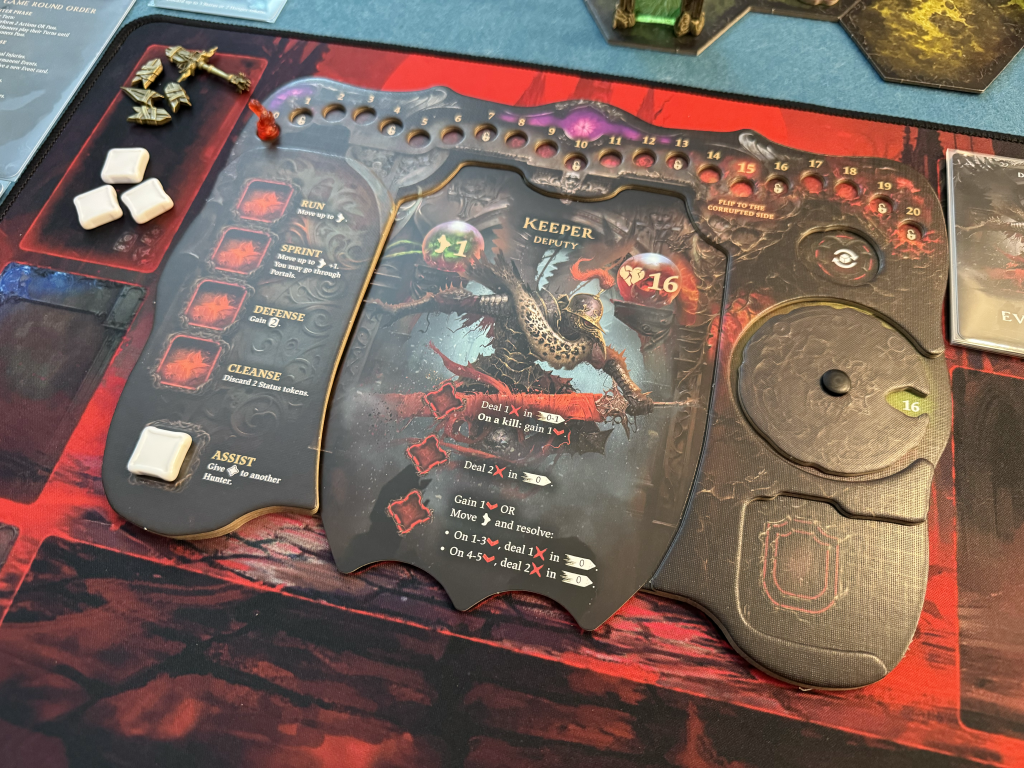
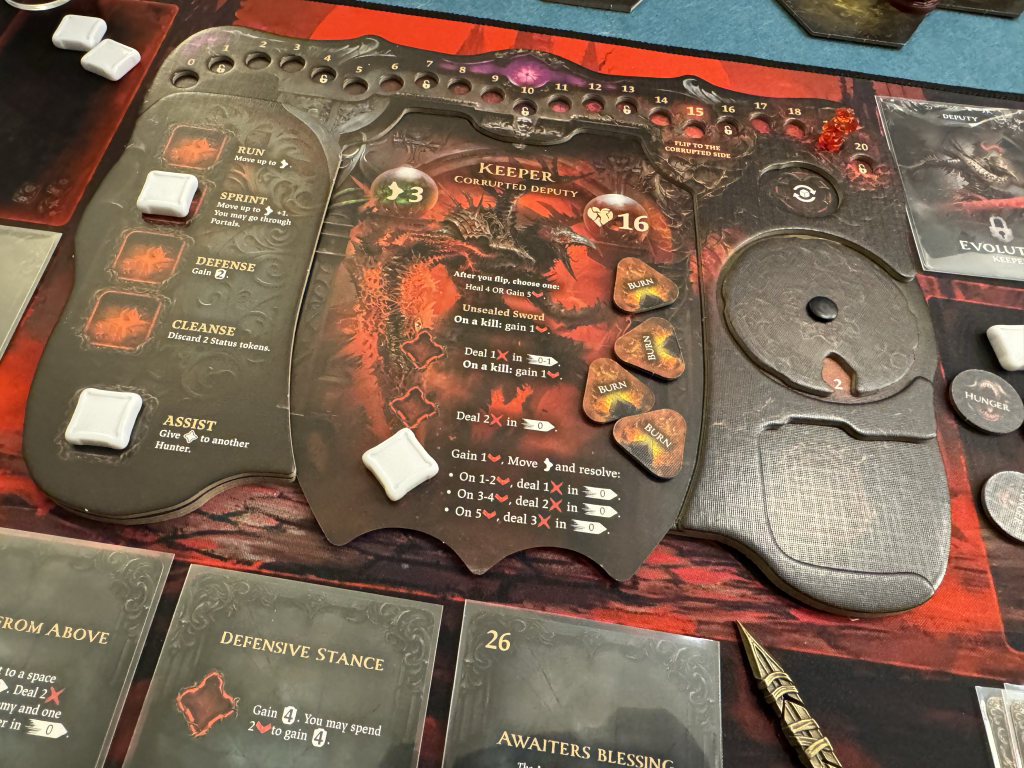
My current favorite Hunters are the Gunslinger, Keeper, and Technomancer. Each one illustrates how differently a Hunter can feel to play. The Gunslinger rewards positioning. You’re forging bullets and choosing exactly when to spend them for bonus damage or special effects so every attack feels like a decision rather than a routine maneuver. The Keeper is the team’s tank. Slow to move at first, built to absorb punishment, and steadily growing into a damage powerhouse as he assembles pieces of his demonic sword. Watching that sword come together over the course of a battle is its own kind of satisfaction. The Technomancer plays differently from either of them as a complex support character with a unique technology die. She can toggle between powering up weapon or armor attachments depending on what the team needs. Put any combination of Hunters on the table and no turns look alike, which is exactly the kind of variety that makes you want to try a different team the moment a game ends.
Even scenario one against the Graveyard Dragon has felt fresh both times I’ve played it, thanks to randomized attack cards and landmarks. The portals are a good example of how the game generates memorable moments. Sometimes you don’t have enough movement to use them, or certain effects render them useless entirely. But when you can land a killing blow on a piece of the Griefbound and then sprint through a portal to dodge a counter-strike, you feel like you’ve survived a moment in a larger war.
Whenever I leave the table already thinking about what I’d do differently next time, I know a game has real replay value. I’ve had multiple conversations after sessions about Hunter combinations and whether we’re ready to push to a higher scenario level. There are also so many minions variants and environment-linked secret cards that a single battle only scratches the surface of what’s in the box. Heavy, cumbersome to organize, but worth it the moment you sit down.
Difficulty modifiers let you tune the experience in both directions. For a first playthrough, I recommend a few easy-mode tweaks. Most just give you a head start on powering up for round one. The Rapid Hunt mode is also worth considering as a standard game can stretch across a couple of hours. This mode cuts the runtime by starting you mid-fight.
Notable Discovery: Corrupted Hunters
My excitement peaks every time I get to swap out my Hunter miniature for its corrupted form. And the path to get there is one of the game’s best mechanics. Lament, the resource that fuels the Griefbound themselves, is also available to Hunters. Spending it levels you up, unlocking evolution cards that might give you an extra attack, or simply an extra die. One die sounds like a modest reward until it’s the resource that lets you pull off a killing strike or pass a crucial symbol to complete a teammate’s combo.
Hunters can also gain hunger tokens which force attacks against your allies. Though my game group hasn’t worried too much about hunger, because collecting more Lament is the only way to flip your player board to the corrupted side. New forms come with new abilities and perks that build on the strength you’ve been stacking through evolution cards. That said, higher corruption has real costs. Negative effects become more frequent, hunger grows, and you risk becoming a Pretender where your Hunter converts into a Griefbound for others to hunt. You can sprint towards corruption deliberately or manage it carefully. Both are valid strategies. Both have consequences.
Notable Discovery: Personal Stories
Grimcoven is not a campaign game with a continuous storyline. Any Griefbound scenario can be played with any team of Hunters, without need to start from the beginning. That said, there is lore woven throughout the Griefbound scenario books and flavor text on the cards themselves. The Personal Stories expansion gives you a way to pull on those threads.
Each Hunter gets a story booklet with missions tied to their playstyle. Complete the Death Jester’s mission of two successful gambles in a single round, for example, and you unlock new cards and story passages that reveal how that character fits into the world. The characters already have distinct designs and mechanics; Personal Stories add motivation. The unlockable cards also give each Hunter additional replayability. My practical note: the story passages can run long so I recommend treating them as a post-game epilogue like a way to wind down after the battle where the Hunters share what they went through. This will preserve pacing during the game and gives the stories their own time to shine.
Observer’s Notes
If you go all-in on the content, the sheer volume of components becomes its own challenge. The core box barely fits everything with miniatures, and organizing it without a system is an exercise in frustration. I solved this by buying a custom insert from Etsy, which lets me fit all expansions, add-ons, sleeved cards, and miniatures into the core box and the Forgotten Entities expansion box. Setup is noticeably faster now, and two boxes instead of a pile saves valuable space on crowded shelves.
Field Report Summary
Current Status: Essential Equipment (Must Own)
Rules Accessibility: The game looks overwhelming at first, but each step is numbered and approachable. The rules themselves are not hard to understand, which makes for a comfortable learning curve, though small details are easy to miss on a first read of the rulebook. Each Hunter and Griefbound brings its own unique rules and, fortunately, Awaken Realms provides an FAQ and errata (link).
Replay Potential: I played scenario one of the Graveyard Dragon twice and each felt genuinely new. Between the variety of Hunters, scenario levels, minion variants, map terrains , and landmarks, you’ll finish a session already planning the next.
Components: The acrylic component upgrades are a mixed bag. Some look like cheap candy and feel out of place next to the rest of the production. Others, like the Keeper’s metal demonic sword and the Gunslinger’s plastic bullets, are thematic and impressive. The cardboard components are uniformly beautiful and legible. The miniatures do the most work. The scale difference between Hunters and Griefbounds pulls you into the world.
Time Investment: Pre-session setup is the hard part. Once you’ve laid everything on the table, the game starts quickly. Expect multiple hours for a standard game. As you familiarize yourself with the systems, turns move faster and that improvement is satisfying to feel happen across game sessions.
Portability: Even consolidated into two boxes, this game is heavy and not built for easy travel. I plan to host when I want to play with friends.
Recommended Team Size: One to three players is the sweet spot. Fewer players means more frequent turns and more time in the action. More players adds strategic depth and planning that suits harder scenarios. The solo mode Deputy can fill the gap of an additional player well enough that you can easily increase your team size.
Artists: Elizabeth Kim, Ferenc Patkós, Kasatka Pixel
Publisher: Almanac Games
Player Count: 1-4
Estimated Play Time: 60-100 minutes
Box Size: 12in x 12in x 4in
Quick Debrief
In this cooperative boss battler, players create a team of two to four characters to encounter a single enemy in a battle. If players can survive without losing all their health points or succumbing to corruption, they win! When you are ready to play, you pick an enemy, create your characters, and get straight to the fight.
I like playing Encounters: Shattered Wastes. The pixel art aesthetics are great. The game size is manageable with a satisfying scale that doesn’t feel like a table hog. Each game feels different and there are plenty of strategic opportunities based on team composition, ability cards, and item cards.
It’s unlikely I will play all the game’s content because of the higher difficulty found in half the enemies. I don’t regret backing the game though. I’m always excited to support first-time game creators and I’ve had fun with this game solo and with friends. However, it’s not a game I will go back to often because I don’t want to invest the time and energy into learning to defeat the most difficult enemies.
Current Status: Useful Gear (Want To Play Again)
Overall, it’s staying in my collection for now and I would recommend fans of boss battles or pixel art Japanese role playing games (JRPG) give it a try.
Initial Observations
The excellent pixel art immediately caught this gamer’s attention. Both the art and game mechanics reminded me of classic JRPG battles in Final Fantasy games. I backed Encounters: Shattered Wastes on Kickstarter in March 2023 and received the Deluxe Edition with an alternate box cover. As a Kickstarter backer, I received a foil version of the Crystal Elixir item card.
Additional components in the Deluxe Edition include:
One of the standout features of Encounters: Shattered Wastes is the replayability. Each game involves creating a unique version of one of the eight characters. The characters have interesting traits and stats that determine their damage output and how to land a critical hit.
Additionally, players are dealt an assortment of ability and item cards that allow for a custom load out each game. It’s fun to pick cards that align with my preferred play style. For example, the martial ability cards offer powerful attacks to overwhelm the enemy while the sorcery ability cards include both big magic attacks and support skills to help boost the team’s chance of survival. The support ability cards are useful for countering the enemy’s rage cards, and the item cards offer powerful effects to recover health points and strengthen characters.
I’ve played the game about a dozen times both as a solo game and with two players. My games have ranged from two to four in-game characters. The game does a good job of scaling the enemy boss by increasing the number of strength cards they start with relative to game character count. While having more characters on your team can mean more opportunities to deal damage, it can mean a longer battle with more enemy attacks to withstand. The enemy boss does not have health points like the players. Instead, they receive more cards in their deck that can lead to battles taking quite a bit longer to complete.
Players must inflict wounds while the enemy shifts between a guarded and staggered stance. This balance of knocking down the enemy to make them vulnerable is rewarding as it requires careful planning to ensure your attacks cause lasting damage. And even when you beat the first form, the enemy will continue to bite back in its injured state. I like seeing the enemy physically change appearance as well as change its battle tactics. The two forms keep players engaged as you need to adjust your strategy for each form of the enemy.
Full Gameboard Setup
Regarding difficulty, the challenge feels fair and the difficult ratings for each enemy feels accurate. The game rules are easy to understand and the rounds run smoothly with only three phases (Refresh, Action, & Defend). Each character is limited to two actions per turn, but there are plenty of opportunities to trigger special abilities to make for satisfying turns. You can often do more than move and a basic attack. I like that from the start, your character feels powerful enough to damage to the enemy and contribute to the team’s efforts.
While players have to roll dice for most attacks, this is balanced out with the threat level mechanic. Rolling dice felt like more of a calculated risk at worst rather than a constant gamble. As long as you roll a higher number than your threat level, you will successfully hit the enemy. And you can lower your threat level with the recover action as well other special abilities.
However, you will need luck when it comes to the enemy strength and rage cards. These face down cards can have nasty effects like giving out debilitating affliction cards, hitting for high damage, or massively raising your threat level. Despite this, there are multiple ways to prepare for the face down cards and, as they cycle through the enemy deck, you can begin to predict what is coming next. That doesn’t mean a clear victory is always in site nor guaranteed, but the times I’ve lost felt fair. The enemies don’t feel like they cheat to win, but rather are so powerful that you have to be prepared to endure every strike until the very end. I anticipate the most challenging enemies will be less forgiving of lackluster turns or poor planning.
Field Testing
In a follow-up solo game against the Harvester, I changed my team to the Slayer, Seer, and Arrowmancer, leaving behind the Ronin and Monk from a previous attempt. I was rewarded for changing from pure damage dealing characters to a more strategic team with sorcery and item cards. I only knew to change my team composition after a quick loss to the Harvester once it was knocked down into its injured form.
Encounters: Shattered Wastes rewards replaying enemy battles, which is a characteristic I don’t often like in games. I’m usually not invested in one game enough to learn all of the enemy card effects. I also like picking characters that pique my interest rather than basing my choice on what abilities will be most advantageous abilities against a specific enemy. However, when I can commit to multiple battles during a game night, understanding what strategies will help you survive throughout a specific encounter has been crucial for victory. If you’re serious about winning, remember that you’ll need to be considerate during the character setup phase.
I’ve found the box to offer a lot of variability between the eight characters and eight enemies. Honestly, Encounters: Shattered Wastes offers more content than I’ll ever play because the more challenging enemies offer a higher level of difficulty than I prefer during my gaming sessions. I do appreciate having the options available because I may decide to use everything one day. In the meantime, I still enjoy playing the weaker enemies solo or with friends.
Additionally, there is an official easy mode (and ways to make the game harder). The designer suggests starting each character a relic card. These are powerful items from the journey mode that can give your team a powerful boost. I think having this option can make the more challenging enemies fun and interesting for casual players.
Notable Discovery: Journey mode
A quick note about journey mode, which I haven’t tried. Encounters: Shattered Wastes is designed for single, independent boss battles. For those who prefer a narrative campaign adventure, journey mode allows for a team of characters to fight through all the enemies back-to-back in increasing difficulty while retaining ability cards, health points, and any relics acquired along the way. It seems like a fun test of skill and would be perfect for a game group that wants continuity between game sessions. It’s also easy to save progress between battles.
Notable Discovery: The Shattered Mechanic
One cool mechanic I want to highlight is “shattering.” In the land of the shattered wastes, when a character maxes out on threat or wants to avoid losing all of their health points, the player board and character card can be flipped over to the shattered side. While the shattered form can save a character from leaving the battle, it transforms them into a glass cannon.
The shattered form of each character has unique traits and stats that are powerful variants of their heroic forms. But by gaining access to shattered ability cards, you must now manage your corruption value (a new loss condition). And yet, this increase in strength can be just what’s needed to defeat the enemy. Overall, I really enjoy the shattering mechanic, because the enemies aren’t the only ones on the board with two forms. It’s also satisfying to know that each character has a second chance to make a comeback against the enemy.
Everyone in this game is susceptible to losing themselves to the corrupted magic in the shattered wastes!
Observer’s Notes
Shoutout to Dión Morales who composed background music for each boss battle. I highly recommend playing the encounter specific tracks during your gaming sessions!
Also, while I prefer the acrylic standees over the cardboard version, they are hard to pack away in the provided GameTrayz insert. A helpful guide was provided by Almanac Games, but it can be annoying to need a guide to put your game back in the box.
Field Report Summary
Current Status: Useful Gear (Want To Play Again)
Rules Accessibility: This game is easy to teach. However, they may be some complex interactions due to character placement on the board and specific ability cards.
Replay Potential: This game offers a wealth of content for a reasonable price, and each battle feels fresh.
Components: Both the acrylic and cardboard components are great. The pixel art is beautiful and really pops. The cards are sturdy and easy to read.
Time Investment: Unfortunately, there is a slight delay between creating your character and initiating the battle. Be prepared to make multiple decisions during character setup. This can be fun for some, but tedious for others. Additionally, if you have the acrylic standees, it may take a while to pack up the game properly.
Portability: All the game components including the neoprene playmat fit in the box.
Recommended Team Size: Two to three players controlling three characters seems to give the best balance of strength and variability in team composition.
Hey there! I’m the your Tabletop Field Guide, and this blog is my new project for 2026. My goal is to play and review all the board games in my collection. Let’s see how much I can accomplish by December 31, 2026.
We can keep track of my board game collection together on BoardGameGeek (@OmegaEXE). I am regularly selling games that no longer interest me and also regularly crowdfunding games. I also own plenty of expansions which will not be reviewed separately.
I’m sure my review style will evolve throughout the year, but I already know I will not use a numerical rating or letter grade. I want to judge my games based on the likelihood that I would play them again. I’ll also comment on whether I’d buy the game again.
My philosophy is that all the board games in my collection should be games that I enjoy playing, even if I don’t play them very often. It will be interesting to see if this review process makes me reconsider keeping a game.
Anyway, I’ll be back soon with my first review of the year.