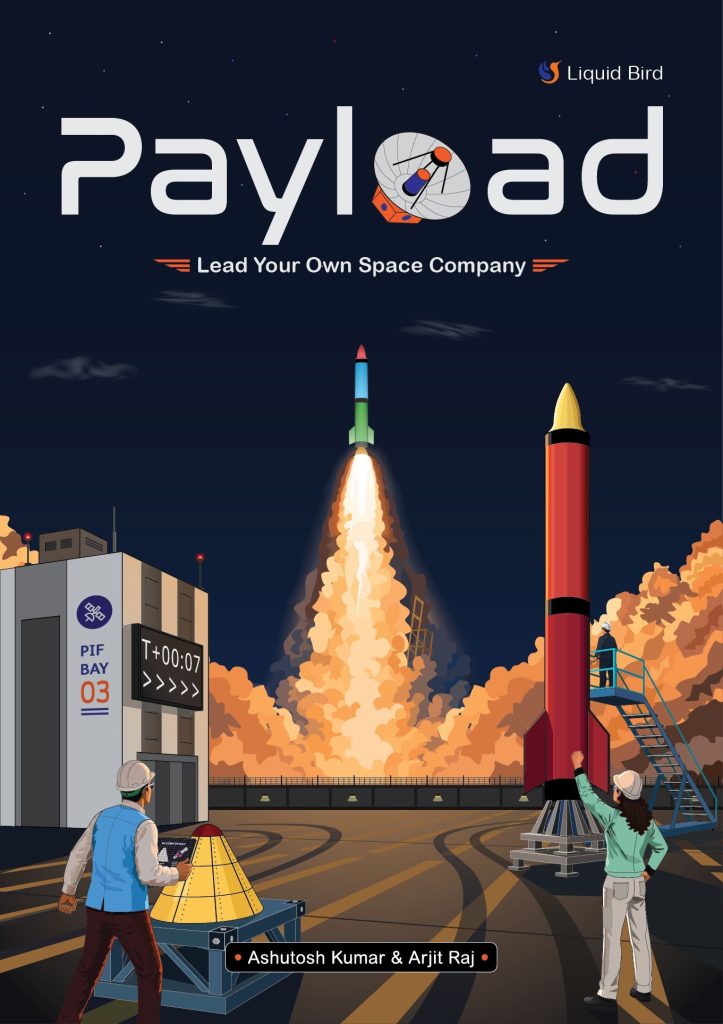
Details
Game Design: Ashutosh Kumar and Arjit Raj
Artist: Arjit Raj
Player Count: 1 – 5
Estimated Play Time: 45 – 60 minutes
Quick Debrief
In Payload, you’re running a scrappy space company trying to outmaneuver rivals in a tight launch economy as you bolt together rockets. Contracts are scarce, weather is fickle, and every upgrade decision feels like an engineering challenge. After a few rounds, the table starts to look less like a pile of cards and more like the desk of a project manager overseeing a rocket development projects.
Payload blends clever bidding, a crunchy rocket‑building puzzle, and a surprisingly thematic launch system. The color‑matching and card upgrade decisions feel meaningful, and the Operations layer adds just enough control to keep launches from being pure luck. Weather, exploding tanks, and tight money all contribute to a sense of running a real and slightly chaotic space program.
This preview is based on a prototype, but the design shows a lot of promise, and I’m excited to continue playing. Check out Payload on Kickstarter: https://www.kickstarter.com/projects/rajarjit/payload
⬇️ Keep reading for my full thoughts ⬇️
Gameplay
Payload is a competitive rocket‑building game where players assemble parts, hire engineers, and bid for launch contracts. You’re trying to build rockets that can actually survive the launch sequence, all while managing a tight money economy and reacting to shifting weather conditions each round.
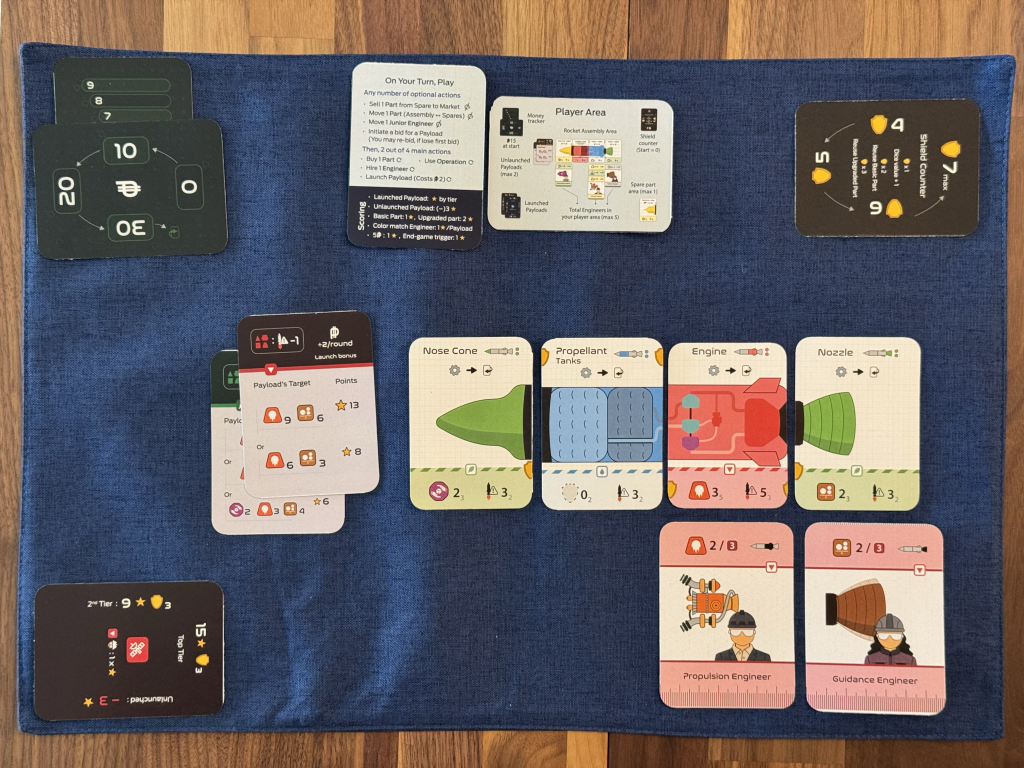
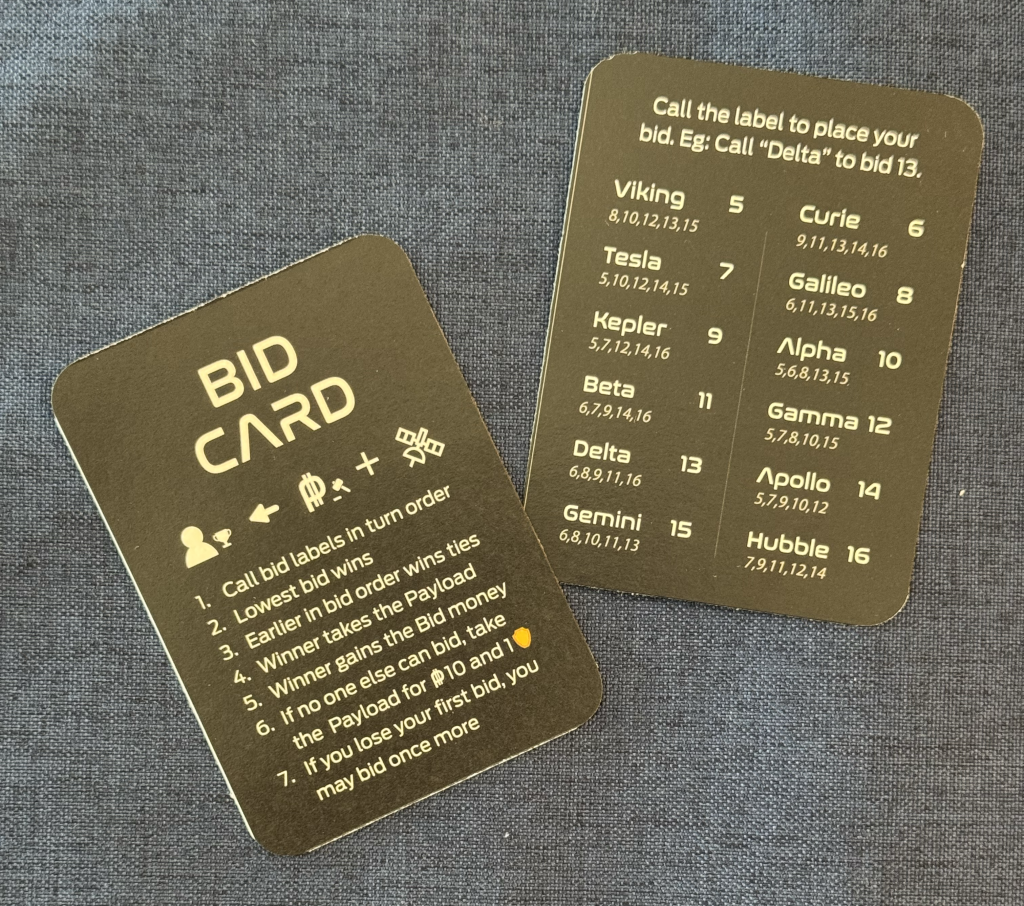
The blind bidding is both a standout and important aspect of this game. Instead of bidding numbers, players call out bid labels tied to hidden values. It’s quick, thematic, and creates a fun uncertainty. You learn to read the table, but you never really know whether your “Gamma” is going to undercut someone else’s “Apollo.” And you have to balance undercutting other players and earning decent profits so that you can actually pay your rocket’s construction costs.
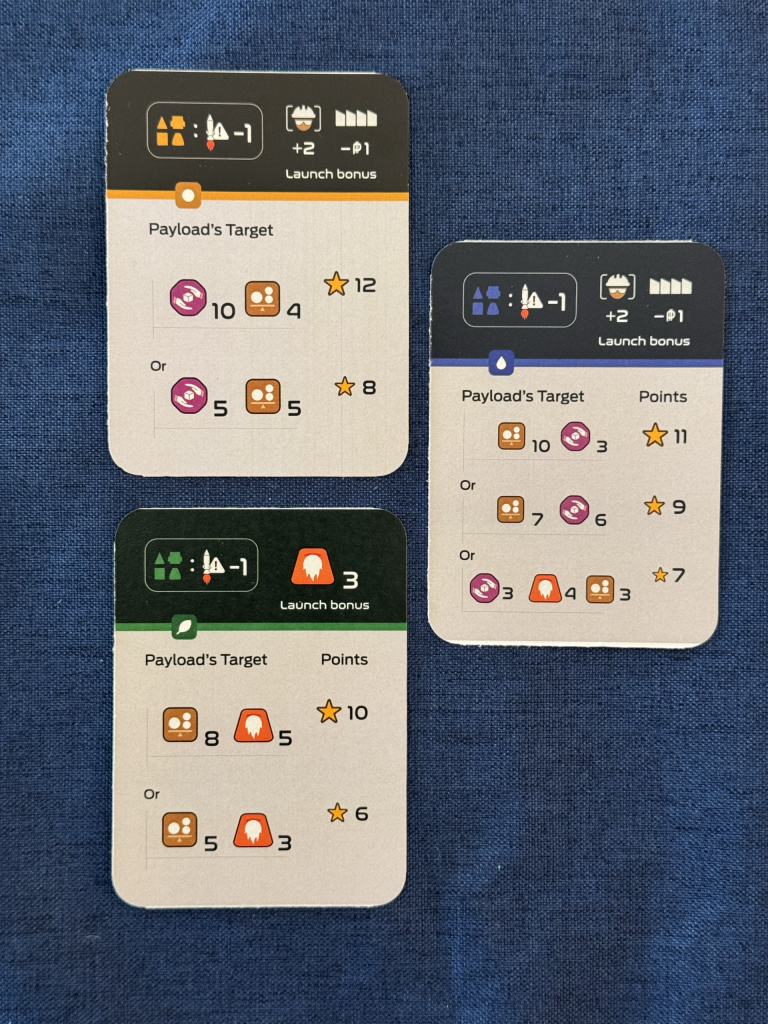
Rocket construction becomes a puzzle of colors and upgrades. You’re constantly trying to keep your Launch Target low enough to survive the launch sequence. Upgrading parts helps lower your risk and increase potential points from your Payload card. Matching colors is important too for gaining shields and other bonuses. This is also tied to hiring the right engineers to help you fulfill your Payload card requirements. But money gets tight fast, and sometimes you are forced to sell Rocket Parts for extra cash. You can’t do everything you want to do, especially because there is a limited number of Payload cards players can complete before the game ends.
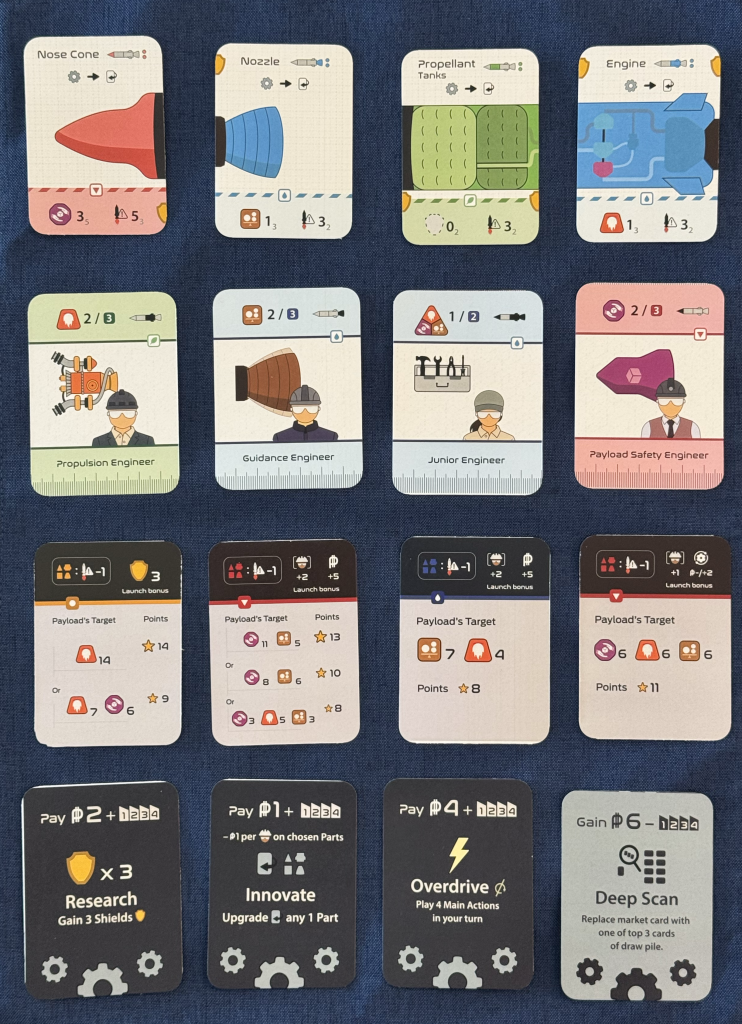
Operation cards add a layer of quiet strategy. Cards like Deep Scan and Reload help you manipulate markets and gain additional funds while you can use Research and Breakthrough to boost your chances at a successful launch through Shields and cards upgrades. Overdrive is the most interesting Operation card because it lets you surpass the limit of two main actions per turn. An extra two main actions in a turn could be all you need to buy a rocket part before your opponent or refresh the market to discover the perfect engineer to boost your rocket’s stability. By using these cards, you start to feel like you’re tuning a mission plan and developing a rhythm as you navigate assembling your best rocket and team of engineers.
Launches are the game’s centerpiece and how you ultimately score points. You roll dice one at a time while factoring in the weather die and decide whether to spend Shields to push a roll value higher. Sometimes you abort and take consolation Shields. Sometimes you push your luck and your Propellant Tanks explode. Even failed launches are thematic and as entertaining as a successful launch. And at the end of the day, both send your engineers back to work on the next rocket.
Field Testing
What I enjoyed most is how Payload balances planning with uncertainty. You can build a beautiful rocket and still sweat the launch. You can line up the perfect bid and still lose to a Bid Label you didn’t expect.
The color‑matching puzzle is fun and gives you a clear goal each round. Upgrading parts feels meaningful. Especially as the card markets shift, and money gets tight. I quickly found myself running low on funds after spending a few turns focused on buying rocket parts and hiring engineers. And when the economy starts forcing you to make tough choices, the strategic planning requirement in this game shines through. Sometimes you want to hire an engineer, upgrade a part, and use an Operation card, but you can only afford one.
It’s also a game where the table stays engaged. Launches are shared moments. Bids are shared moments. Even market shifts feel communal. There was a moment early in a game of Payload where someone called out “Delta” during a contract bid, and the whole table paused. Another player responds with “Gemini,” and suddenly everyone is leaning in, trying to remember which bid label might be low this round. It was a small and funny moment that set the tone for the rest of the game.
What kept me invested in my games of Payload were the little moments where the table energy shifts. You can see everyone’s Player Area. Their money tracker, their shields, the parts they are assembling and the corresponding engineers. This leads to a satisfying sense of pressure as you judge your progress relative to everyone else’s and decide how many turns you have to complete your objective.
Notable Discovery: The Weather Die
Each round begins with a weather die roll, and that value becomes one of your three launch dice. It’s a simple addition, but it adds to the game’s theme. Sometimes the skies are clear and you feel invincible; sometimes you’re staring down a “2” and wondering if you should abort the launch for some Shields.
Observer’s Notes
There is a Solo Mode in the rulebook that allows you to play against Tycoon, Earth’s richest space agency. I did not give this mode a try, but I appreciate when designers provide options for solo board gamers.
Field Report Summary
This preview is based on a prototype, so I’m not assigning a final rating. But Payload already shows a strong sense of identity: clever bidding, a satisfying rocket‑building puzzle, and a launch system that creates real tension. I’m curious to play this with more friends, especially to see how the Operation cards flow and how different players react to the bidding system.